
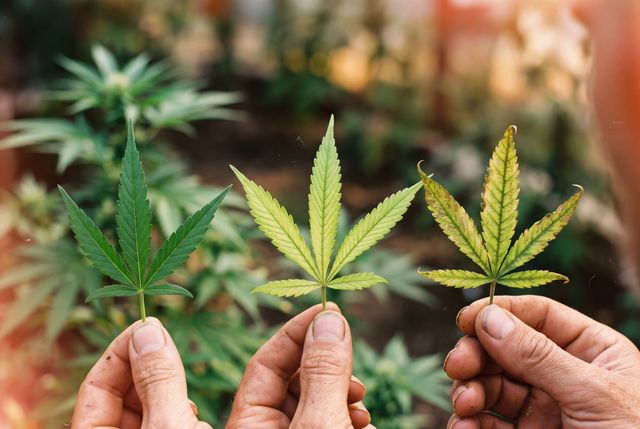
Cannabis Deficiencies Guide & Symptoms Chart
Your cannabis plant tells you what it needs through its leaves. Most cannabis deficiencies start there, and once you learn the signs, they're easy to catch and fix. This guide covers every common cannabis nutrient deficiency, with a clear chart, leaf-by-leaf symptoms and practical fixes for each one.
You'll also learn why problems happen even when you feed correctly. By the end, you'll read your plants with confidence and prevent most shortages before they ever slow down your grow.
Here's the quick version:
Most cannabis deficiencies show in the leaves first. Yellowing on older, lower leaves usually means a mobile nutrient like nitrogen is short. Damage on fresh top growth usually means an immobile nutrient like calcium or iron is short. Always check your pH before adding anything, because the wrong pH locks out nutrients and mimics a deficiency even when your feed is fine.

Gabriel ILGM
Table of contents
What Are Cannabis Deficiencies?
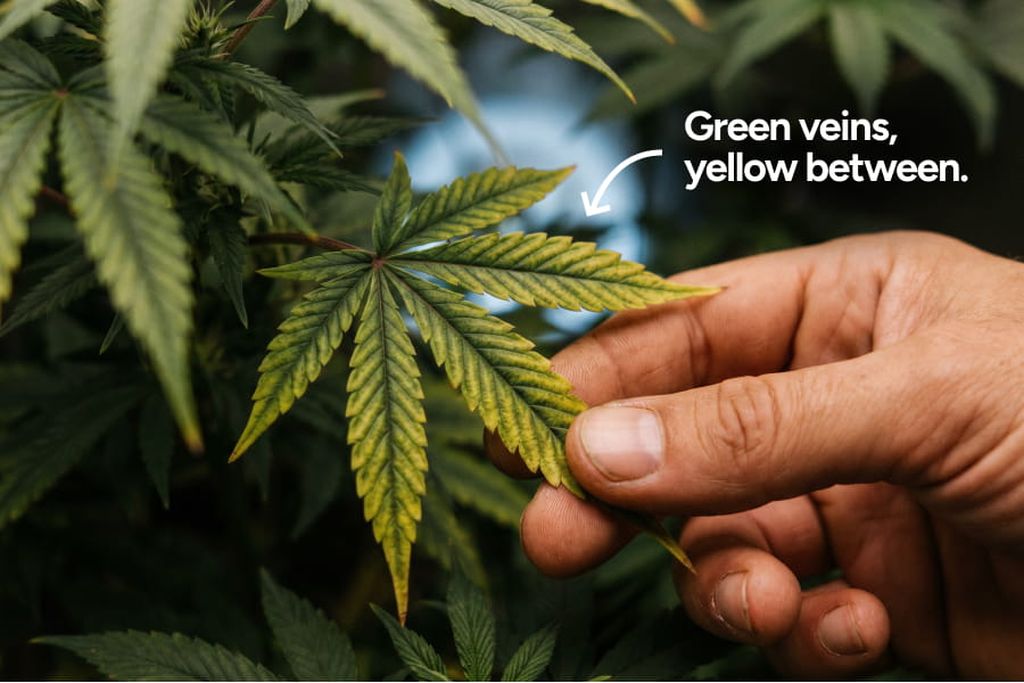
A cannabis deficiency happens when your plant can't take up enough of one essential nutrient. Even a healthy feed can't make up for one missing mineral, so growth, bud size and quality all suffer.
Marijuana plants need three groups of nutrients:
Macronutrients are the ones cannabis uses in large amounts, mainly nitrogen, phosphorus and potassium.
Secondary nutrients (calcium, magnesium and sulfur) sit in the middle.
Micronutrients are trace minerals like iron, zinc and manganese that plants need in tiny amounts but can't grow without.
A shortage in either group shows up fast. Weed plants slow down, leaves change color and your harvest takes the hit. The good news is that most cannabis deficiencies are easy to spot and reverse once you know the signs.
Why Do Cannabis Deficiencies Happen Even With Feeding?
Cannabis deficiencies often appear even with a full feed, because pH, watering or root health blocks nutrient uptake. The most common cause is pH. Roots only absorb nutrients within a narrow pH range, so a reading that drifts too high or too low shuts absorption down.
When that happens you get cannabis nutrient lockout, where the nutrients sit in the medium but the roots can't reach them. Adding more feed only makes it worse.
Aim for a pH around 6.0 to 6.3 in soil (with 6.5 as the hard ceiling) and 5.8 to 6.2 in hydro or coco coir. Drift above that and phosphorus, manganese and iron start locking out, which fakes a deficiency even when your feed is fine.
Check pH every time you feed, because water and nutrients both shift the number. Overwatering and packed, low-quality soil also stress the roots and trigger the same false signals.
How Do You Read Cannabis Leaves for Deficiency Signs?
Cannabis leaves signal most deficiencies through three things: color, spotting and curl. The trick is knowing where to look, because the location on the plant tells you which nutrient is short. Start by checking whether the problem hits old lower leaves or fresh new growth.
Mobile Nutrient Deficiencies (Older Leaves First)
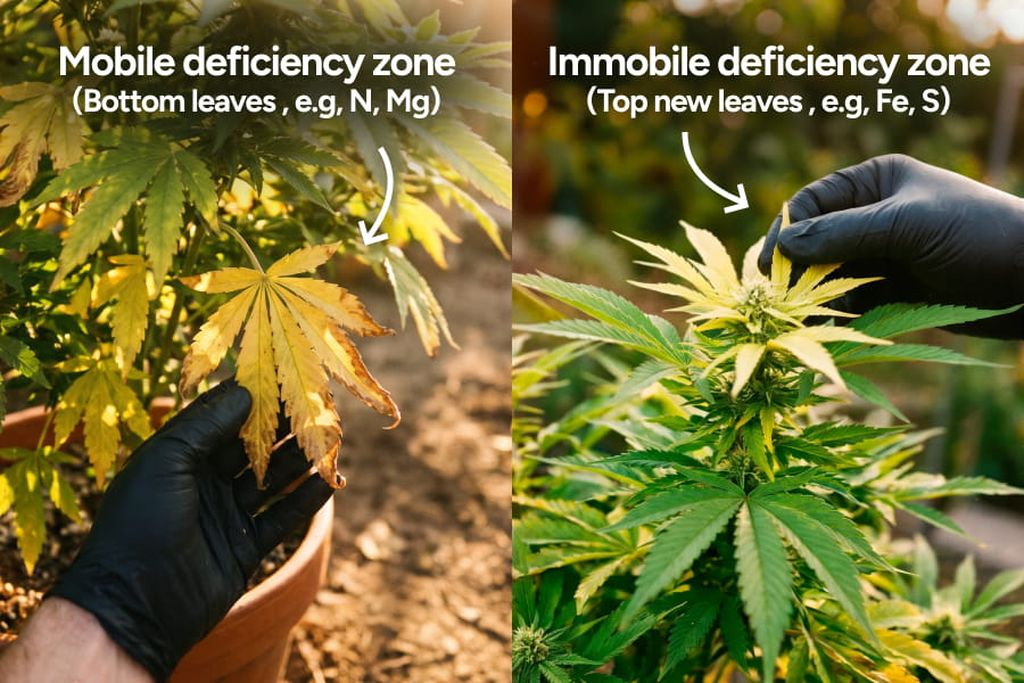
Mobile nutrients move from old leaves to new growth, so shortages show on lower, older leaves first. The plant pulls these nutrients out of older fan leaves to feed fresh tops. Nitrogen, phosphorus, potassium and magnesium all behave this way. Check a mobile nutrient first, if your lower leaves yellow or spot while the top stays green.
Immobile Nutrient Deficiencies (New Growth First)
Immobile nutrients stay put once the plant uses them, so shortages show on new top growth first. These nutrients don't move backward to rescue fresh leaves. Calcium, iron, zinc, manganese, sulfur and boron sit where they land. Suspect an immobile nutrient when your newest leaves twist, pale or spot while older leaves look fine.
Here are the most common leaf signals paired with their likely nutrient and how much to trust each clue:
Whole-leaf yellowing starting on lower leaves — points to nitrogen. Shows on older growth. High reliability.
Interveinal yellowing with green veins on lower leaves — points to magnesium. Shows on older growth. High reliability.
Brown, crispy tips and edges on lower leaves — points to potassium. Shows on older growth. High reliability.
Distorted, clawed new growth with brown spots — points to calcium. Shows on new growth. High reliability.
Interveinal yellowing on new top leaves — points to iron. Shows on new growth. Medium reliability.
Pale, lime-green new leaves — points to sulfur. Shows on new growth. Medium reliability.
Purple stems and leaf stalks — may indicate phosphorus, cold stress or genetics. Shows on older growth. Low reliability.
High-reliability signals can confirm a problem on their own. Treat low-reliability signals like purple stems as a hint, not proof, and confirm with pH and feed history.
Once you spot a signal, here's how to read your confidence level and what to do next:
pH out of range plus yellowing — likely lockout, not a true shortage. Suspected. Flush, correct pH and reassess before changing your feed.
Lower leaves yellowing with pH in range — nitrogen shortage. Confirmed. Add nitrogen to the feed.
Crispy brown tips after heavy feeding — nutrient burn, not a deficiency. Confirmed. Cut feed strength and flush if the damage is severe.
Twisted new growth with pH in range — calcium or boron shortage. Suspected. Add Cal-Mag and recheck new growth after a week.
Interveinal yellowing on old leaves with green veins — magnesium shortage. Confirmed. Add magnesium or Cal-Mag.
Work the confirmed signals with confidence. For suspected causes, fix the most likely issue first and give new growth a week to respond before changing anything else
Cannabis Nutrient Deficiency Chart
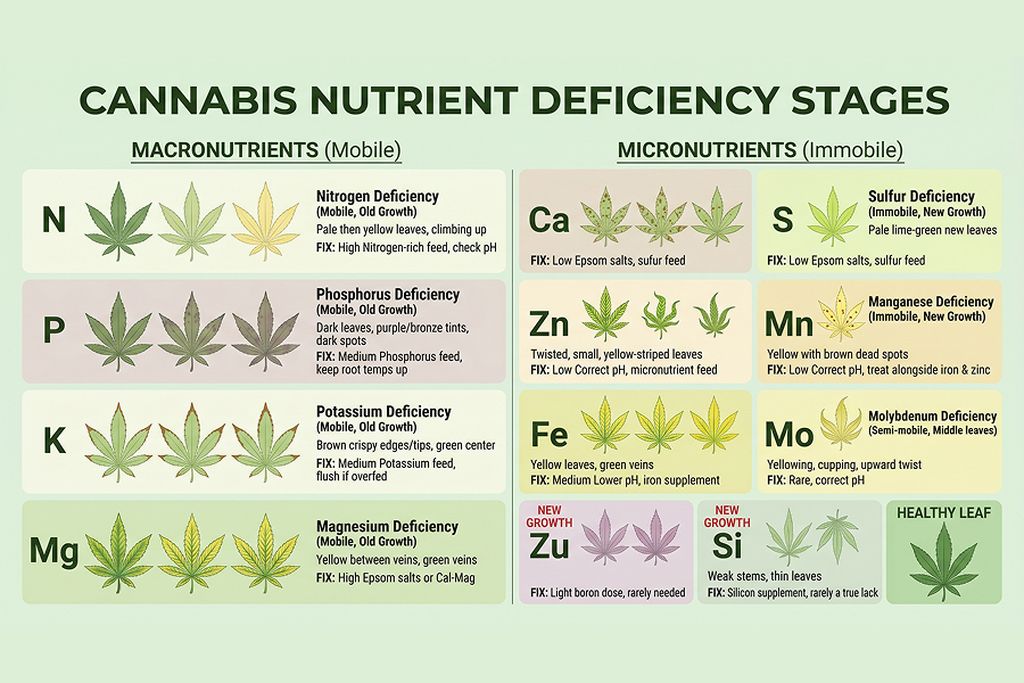
This cannabis nutrient deficiency chart maps each nutrient to its leaf symptom, where it shows and how to fix it. Use it as a quick reference, then jump to the sections below for the full fix.
Treat the chart as a starting point. Match it against your plant's leaf position and pH, then move to the fix sections below for the full step.
How Do You Treat Macronutrient Deficiencies in Cannabis?
Macronutrient deficiencies cover nitrogen, phosphorus and potassium, the three nutrients cannabis uses most. These shortages are the most common, so they're the first ones to rule out.
Nitrogen deficiency in cannabis: yellow lower leaves, the most common shortage to catch.
Phosphorus deficiency in cannabis: dark leaves with purple or bronze tints.
Potassium deficiency in cannabis: brown crispy tips and edges on older leaves.
Nitrogen Deficiency in Cannabis
Nitrogen deficiency turns lower, older leaves pale, then yellow, before they curl and drop. The yellowing climbs up the plant as the shortage spreads. Nitrogen drives leafy veg growth, so this hits hardest before flowering.
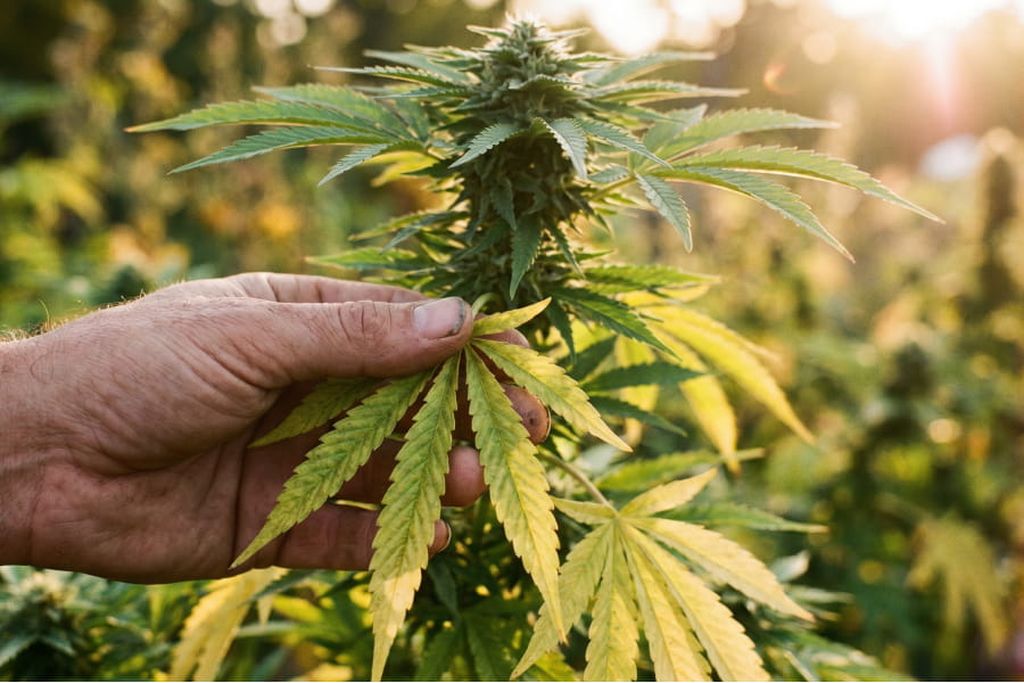
The Fix: Most balanced feeds fix it fast, because they already run high in nitrogen. A light foliar spray of seaweed or fish-based nutrients works as a quick top-up. Watch for the opposite problem too, since too much nitrogen darkens leaves and curls them into a claw.
Phosphorus Deficiency in Cannabis
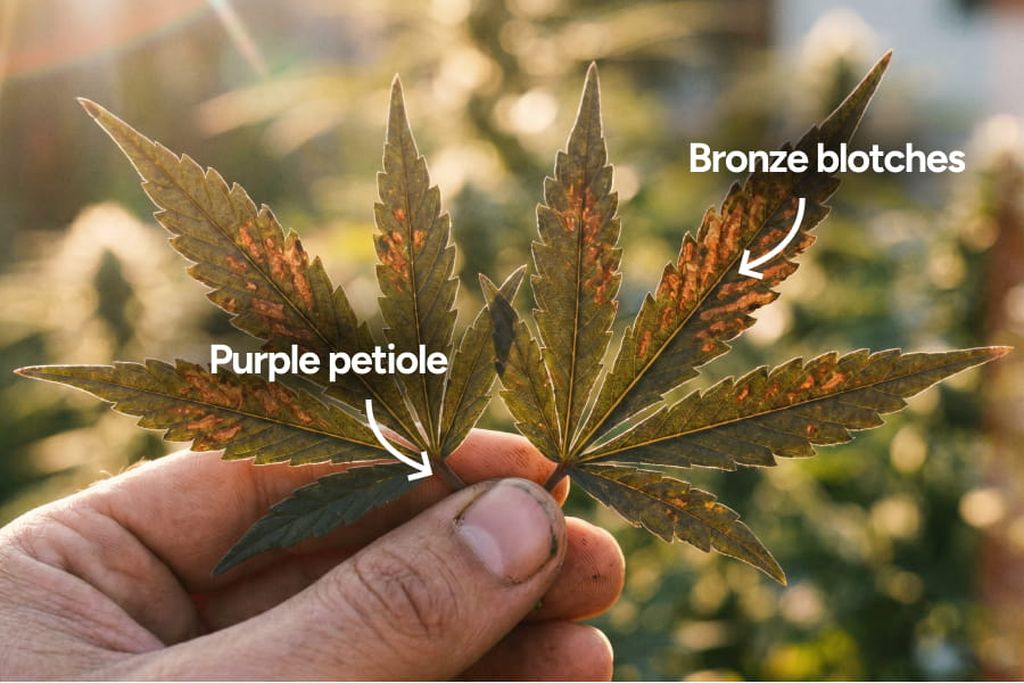
Phosphorus deficiency darkens older leaves and adds purple or bronze tints with brown spots. Leaf stalks can turn purple and growth slows in both height and width. Cold roots make it worse, because phosphorus uptake turns sluggish once the root zone drops below 50°F.
The Fix: Keep your pH near 6.0 to boost uptake, then add a phosphorus-rich feed. Worm castings and fish meal work well for organic grows. Warm the root zone if your space runs cold.
Potassium Deficiency in Cannabis
Potassium deficiency burns the tips and edges of older leaves brown while the veins stay green. Leaves curl, spot and the plant may stretch with weak stems. Buds also fill out slower, because potassium drives sugar transport and flower weight.
The Fix: Flush first if you suspect overfeeding, since too much of other nutrients blocks potassium. Then feed a potassium-rich nutrient or an organic seaweed foliar spray. Recheck pH, because lockout often hides behind a potassium shortage.
How Do You Treat Secondary and Micronutrient Deficiencies?
Secondary and micronutrient deficiencies involve calcium, magnesium, sulfur, iron, zinc, manganese and a few trace minerals. Many of these shortages trace back to pH, so correct that before reaching for a supplement.
Calcium deficiency in cannabis: distorted new growth and brown spots.
Magnesium deficiency in cannabis: interveinal yellowing on older leaves.
Sulfur deficiency in cannabis: pale new leaves, unlike nitrogen.
Iron deficiency in cannabis: yellow new growth with green veins.
Zinc deficiency in cannabis: twisted new growth and thin leaves.
Manganese deficiency in cannabis: yellowing young leaves with brown spots.
Boron, copper and molybdenum deficiencies: rare trace-mineral shortages.
Calcium Deficiency in Cannabis
Calcium deficiency distorts new top growth and leaves brown spots on lower leaves. New leaves can curl, twist or die at the tips, and root tips suffer too. Calcium builds strong cell walls, so a shortage leaves the whole plant weak.
The Fix: A Cal-Mag supplement fixes it fast. Keep your feed from running too alkaline, and add dolomite lime to soil as a slow-release prevention.
Magnesium Deficiency in Cannabis
Magnesium deficiency yellows the area between the veins of older leaves while the veins stay green. Rust-colored spots follow, and untreated plants lose leaves fast. Magnesium sits at the center of chlorophyll, so the plant can't make energy without it.
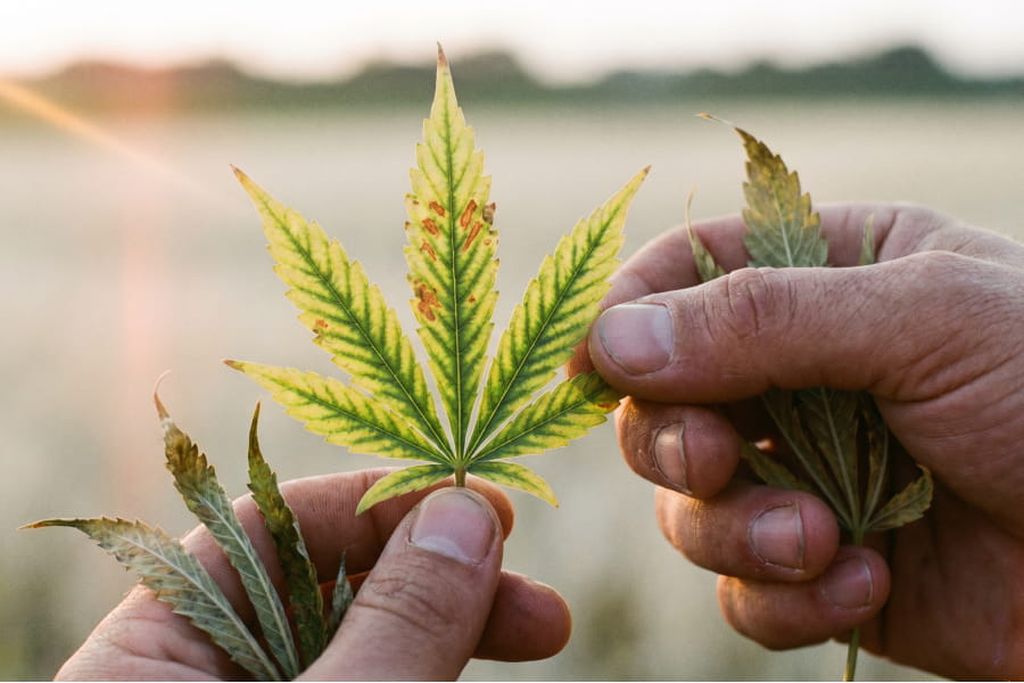
The Fix: Add a teaspoon of Epsom salts per gallon of water, or use a Cal-Mag feed. Flush with pH 6.0 water first if your readings drifted.
Sulfur Deficiency in Cannabis
Sulfur deficiency pales newer leaves to lime green, unlike nitrogen which hits older leaves first. Growth slows and leaves can turn dry and brittle. True sulfur shortages stay rare, and warmer temperatures, which slow sulfur uptake, are the usual cause.
The Fix: Add Epsom salts or a sulfur-rich feed, and keep pH around 5.5 to 6.0.
Iron Deficiency in Cannabis
Iron deficiency yellows new top leaves between the veins while the veins stay green. The newest growth shows it first, then it spreads down. A high pH or too much zinc, manganese or copper usually blocks iron.
The Fix: Lower your pH to around 5.8 to 6.2 and add an iron chelate if needed. Iron drops out of solution fast above 6.0, so the bottom of that range keeps it available. Go slow, since iron reacts with other nutrients.
Zinc Deficiency in Cannabis
Zinc deficiency twists new growth and yellows the area between the veins on young leaves. New leaves grow thin, wrinkled and small, and bud sites can stall. Alkaline soil and high pH bring it on most often.
The Fix: Lower the pH and feed a chelated zinc micronutrient for quick recovery.
Manganese Deficiency in Cannabis
Manganese deficiency yellows young leaves from the base outward, then adds brown necrotic spots, meaning dead tissue. Veins stay green while the spaces between them fade. A high pH is the usual cause, and it often shows up alongside iron and zinc shortages.
The Fix: Flush with pH 6.0 water, feed a light balanced nutrient formula and add manganese chelate if it lingers.
Boron, Copper and Molybdenum Deficiencies
Boron, copper and molybdenum deficiencies are rare, because most quality mediums and feeds already supply enough. Boron shortage twists new growth and browns leaf edges. Copper shortage darkens and twists leaves with slow wilting. Molybdenum shortage yellows older leaves and cups them upward.
The Fix: These trace minerals are hard to dose safely, so prevention beats treatment. Start with quality soil and a complete feed, and correct pH before adding anything else.
How Do You Tell Nutrient Burn From a Deficiency?
Nutrient burn shows as brown, crispy leaf tips from too much feed, the opposite cause of a deficiency. A deficiency means too little of a nutrient, while burn means too much. Knowing the direction matters, because the fixes pull opposite ways.
Read the pattern to tell them apart. Burn starts at the very tips and follows heavy feeding or strong nutrients. A deficiency follows a pattern by leaf position and color, like yellowing that climbs from the bottom.
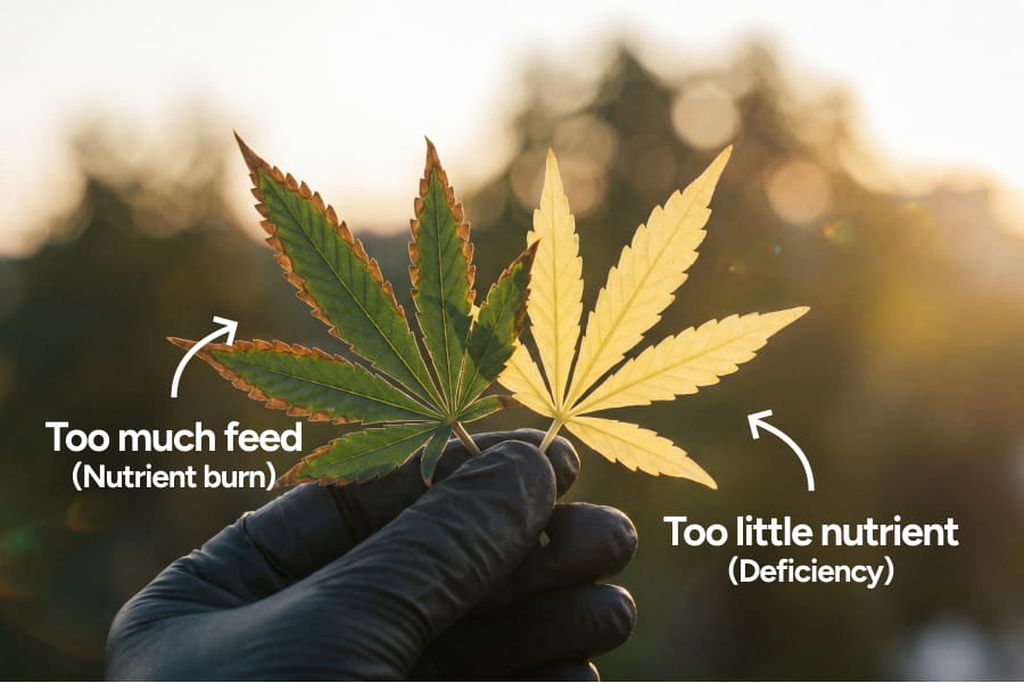
The Fix: Cut your feed strength and flush with pH water for burn. Add the missing nutrient for a true deficiency. Ease off feeding first when you're unsure, since overfeeding does more damage than a small shortage.
How Do You Prevent Cannabis Deficiencies?
Cannabis deficiencies stay rare when you control pH, water correctly and start with good soil. Prevention beats treatment every time, and these habits keep your plants healthy.
Start with the basics:
Use a pH meter and check every feed, since pH problems cause most false deficiencies.
Pick large containers of quality, pre-buffered soil, because more soil means a bigger nutrient reserve for the roots.
Feed on a consistent schedule with balanced cannabis nutrients, and lean on slow-release organics to keep the medium topped up. A steady routine prevents both burn and shortage.
Prevention also starts before germination, because healthy cannabis seeds grow into plants with the vigor to handle small mistakes. New growers often do best with forgiving beginner cannabis seeds that bounce back from minor feeding slips.
How Seed Genetics Help Plants Resist Nutrient Stress
Strong seed genetics give plants the vigor to shrug off minor nutrient stress. Stable, healthy plants also show deficiency signs more clearly, which makes problems easier to catch early.
High-quality feminized seeds produce predictable, vigorous plants that read clearly when something's off. Autoflower seeds prefer a lighter feed, so a gentle schedule prevents both burn and shortage.
Good genetics won't replace good pH and feeding, but they give you a healthier starting point. Pair the right seeds with the habits above, and most deficiencies never get the chance to show up. Remember to check federal, state and regional laws before purchasing or germinating any weed seeds.
FAQs About Cannabis Deficiencies
What Nutrient Deficiency Causes Purple Leaves?
Phosphorus deficiency is the most common nutrient cause of purple leaves and stems. Cold temperatures and natural genetics also turn some plants purple, so check your pH and root-zone temperature before adding phosphorus.
Do Drooping Leaves Mean a Nutrient Deficiency?
No, drooping leaves usually point to watering problems, not a nutrient shortage. Overwatering and underwatering both cause droop, so check your soil moisture and pot drainage first.
Can Low Humidity Cause Cannabis Leaf Curl?
Yes, low humidity and heat can curl your cannabis leaves even when nutrients are fine. Raise the humidity and cool the space before treating it as a deficiency.
Is It Nutrient Burn or a Potassium Deficiency?
Check where the damage starts. Nutrient burn browns the very tips after heavy feeding, while a potassium shortage burns the tips and edges of older leaves with yellowing

Gabriel ILGM
Gab Wulff is an ecologist and designer linking sustainability, community gardening, and cannabis reform.