How to Germinate Cannabis Seeds: The Complete Guide
Knowing how to germinate marijuana seeds correctly is the first real skill every grower builds. Germinating cannabis seeds doesn't require special equipment. You just need the right conditions, a clean workspace and a little patience.
This guide covers five methods for germinating weed seeds: paper towel, water, direct soil, Jiffy pellets and Rockwool. It also explains how long the process takes, how to plant after the taproot appears and what to do when seeds are slow to pop.

Gabriel ILGM
Table of contents
Before You Start Germinating Cannabis Seeds
Starting with fresh, high-quality cannabis seeds is the first step. Once that’s sorted, get your setup ready — it matters as much as method. The best way to get optimal germination rates is by working in a clean, stable and warm environment. The same conditions apply whether you're working with feminized seeds or autoflowering seeds. Here are some pointers:
Check the applicable rules. Make sure cannabis cultivation is permitted by your federal, state and local rules before germinating any weed seeds.
Clean your workspace first. Wipe your surface with isopropyl alcohol and use sterilized tweezers when handling seeds. Contamination is one of the most common causes of early germination failure.
Use clean water. Distilled water or bottled spring water is the safest choice for soaking and spraying. Chlorinated tap water can interfere with germination in some setups.
Keep conditions warm, dark and stable. A closed cupboard holding steady between 70 and 80°F is all you need, no matter the germination method. Sudden temperature swings or light exposure can slow or stop the process entirely.
Check once a day, not more. Lifting the lid every few hours lets humidity escape and disturbs seeds that are just beginning to crack. Checking every 24 hours is enough.
How to Germinate Cannabis Seeds: Paper Towel Method
Cannabis seeds germinate reliably using two damp paper towels, a plastic tub and a dark cupboard kept at 70 to 85°F. This method is one of the most popular starting points. It lets you watch for the taproot, called the radicle, before you commit to transplanting.
The paper towel method is also the only technique covered in ILGM's germination guarantee. If you're using cannabis seeds from our store, this is the method we recommend.
This section covers three things:
A quick checklist of what you need before you start.
The step-by-step process, from labeling to transplanting sprouted seeds.
Common issues with the paper towel method and how to fix them.
Supplies You'll Need for the Paper Towel Method
You need just a handful of basic items to get started with the paper towel method:
Thick, unbleached paper towels (2 sheets per batch)
A small plastic tub with a lid
A spray bottle with clean distilled or bottled water
Sticker labels and a pen
Your cannabis seeds
A dark, warm storage space
Clean hands or gloves
Make sure your hands, tub and spray bottle are clean before you start. Contamination at this early stage can prevent seeds from ever sprouting.
Step-by-Step Paper Towel Germination
Most seeds show a taproot within 2 to 7 days using this method, though fresh genetics at ideal temperatures can be on the faster end of that window, taking 48 to 72 hours.
Step 1. Write your strain name and date on a sticker label and attach it to the outside of your plastic tub. If you're germinating more than one strain, label each tub separately so you don't mix them up.
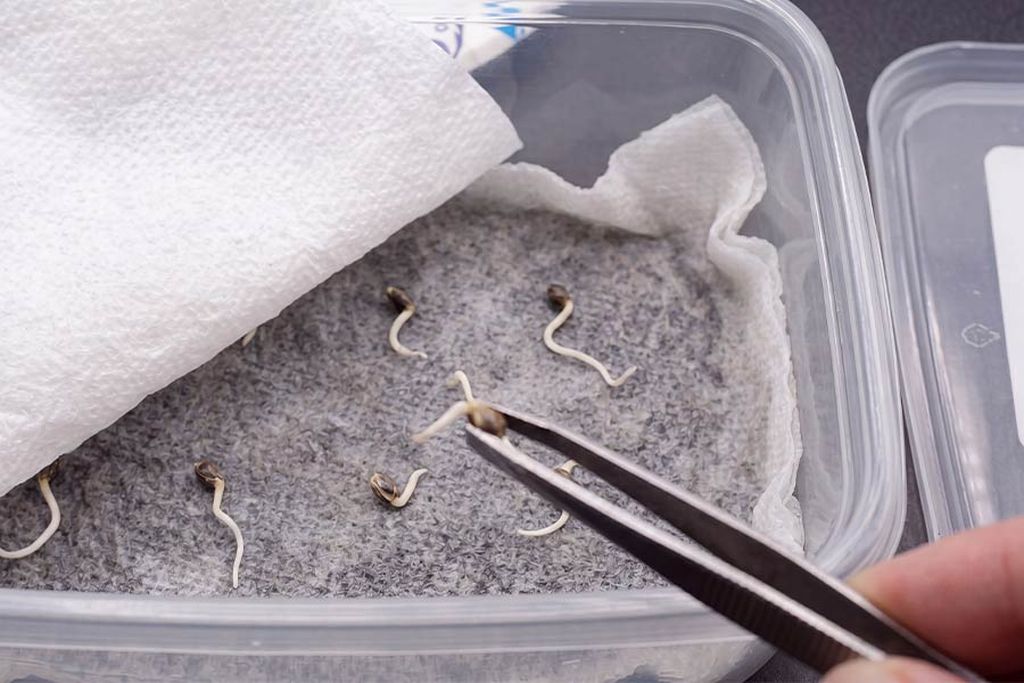
Step 2. Spray a sheet of paper towel until it's damp but not dripping. With clean hands (or gloves on), fold it to fit inside your tub and lay it flat at the bottom.
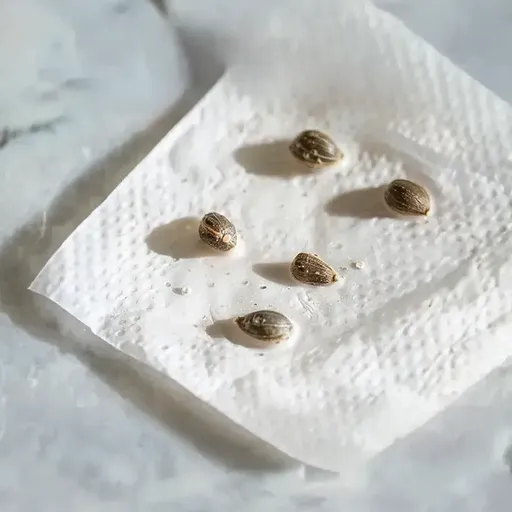
Step 3. Space your seeds on the damp paper towel, leaving at least an inch between each one. This gives the roots room to emerge without tangling.
Step 4. Spray a second sheet of paper towel until damp, fold it to size and lay it over the seeds like a blanket. Both layers should feel moist when pressed but shouldn't leave water on your fingers.
Step 5. Put the lid on the tub. The lid traps moisture so the paper towels don't dry out between checks.
Step 6. Place the tub in a dark, warm spot around 70 to 80°F and check every 24 hours. Avoid disturbing the seeds too much when you check.
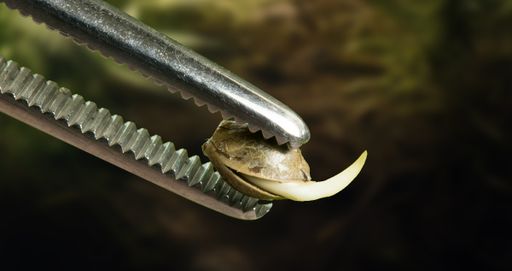
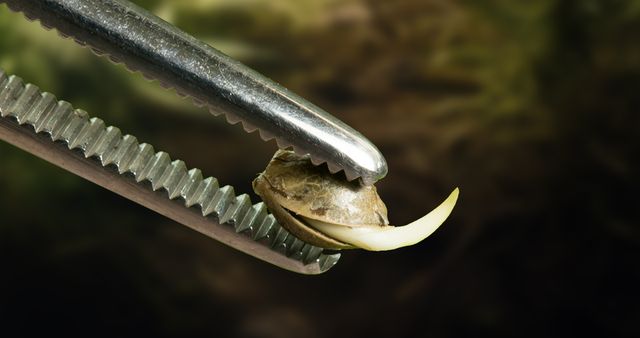
Step 7. Once you see a white taproot poking out of a seed's shell, that seed is ready to transfer. The root should be about half an inch long before you move it to your growing medium.
What Can Go Wrong with the Paper Towel Method?
Three issues cause most paper towel germination failures: a stuck taproot, a paper towel that's too wet and a paper towel that's too dry.
Stuck taproot. When the radicle first emerges, it grows tiny root hairs that can latch onto paper fibers. Always pick up each seed gently from the shell, not the root. If it feels stuck, don't force it free.
Paper towels are too wet. Standing water in the tub blocks the oxygen seeds need to germinate. The towel should feel damp when pressed but shouldn't drip at all.
Paper towels are too dry. Leaving the lid off lets moisture escape quickly. Always close the tub between checks, even brief ones.
Cold temperatures. Seeds germinate best between 70 and 80°F. Below 65°F, the process slows significantly and can stop entirely.
How to Germinate Weed Seeds in a Glass of Water
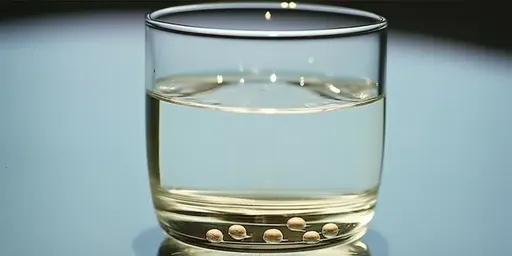
Soaking weed seeds in room-temperature water triggers imbibition, the process that gets the seed's growth enzymes activated. Keep the seeds soaking for 24 to 48 hours in a dark, warm spot and check on them once a day.
This method works on its own for most seeds. It's also an effective first step before moving seeds to the paper towel and can give older or stubborn seeds a better shot at sprouting.
Step-by-Step Water Germination for Weed Seeds
Here’s a list of steps to germinate your cannabis seeds using a glass of water:
Step 1. Write the strain name and date on a label and stick it to a clean cup. Fill the cup with at least two inches of room-temperature water.
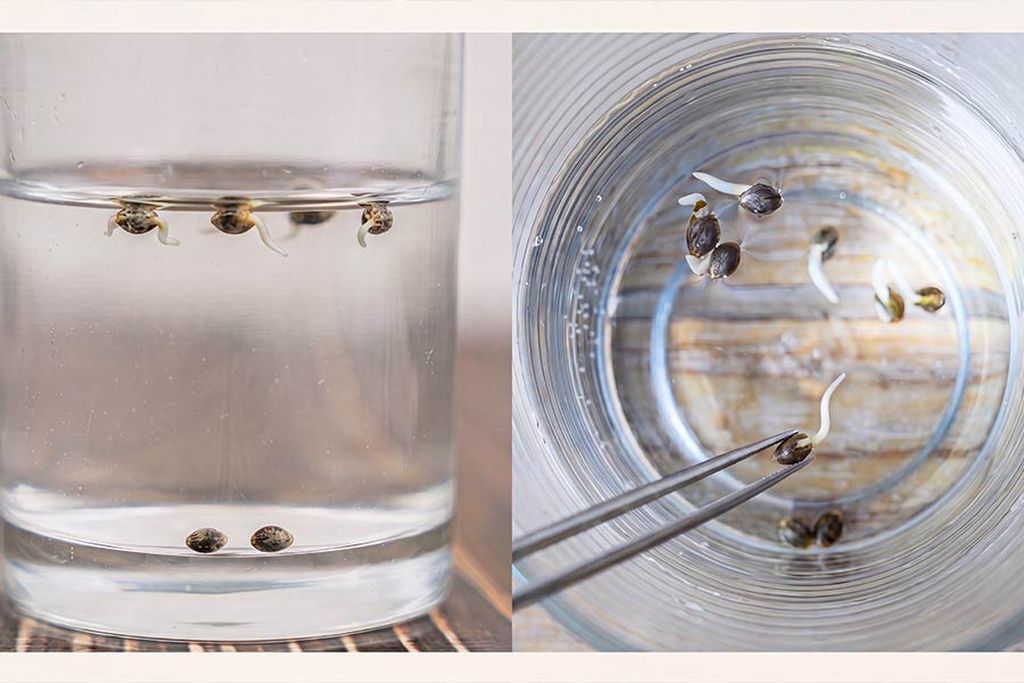
Step 2. Drop your seeds into the water carefully. They'll likely float at first because of air trapped in the shell.
Step 3. Set the cup in a dark, warm location and check every 24 hours. Most weed seeds sink to the bottom as they absorb water, which is a reliable viability indicator.
Step 4. Seeds still floating after 24 hours aren't necessarily dead. Give them a gentle push below the surface and wait another 24 hours.
Step 5. Once you see a white taproot emerging from a seed, remove it carefully with sterile tweezers. Transfer it to your growing medium with the root pointing downward.
What Can Go Wrong When Soaking Weed Seeds?
Cold water, knocked-over cups and marijuana seeds that won't sink are the three most common setbacks with the water method.
Cold water. Weed seeds need warmth to germinate. Cold tap water or a cold storage location slows the process and can prevent the shell from cracking at all. Aim for room temperature water (bottled or distilled) throughout the soak.
Knocked-over cup. It's an easy accident that can set you back a full day. Find a stable shelf in a cupboard and move carefully when checking on your seeds.
Seeds that won't open. If a seed hasn't cracked after 48 hours in water, move it to a damp paper towel and continue there. Some marijuana seeds need extra time and the enclosed warmth of a covered tub to get going.
How to Germinate Cannabis Seeds Directly in Soil
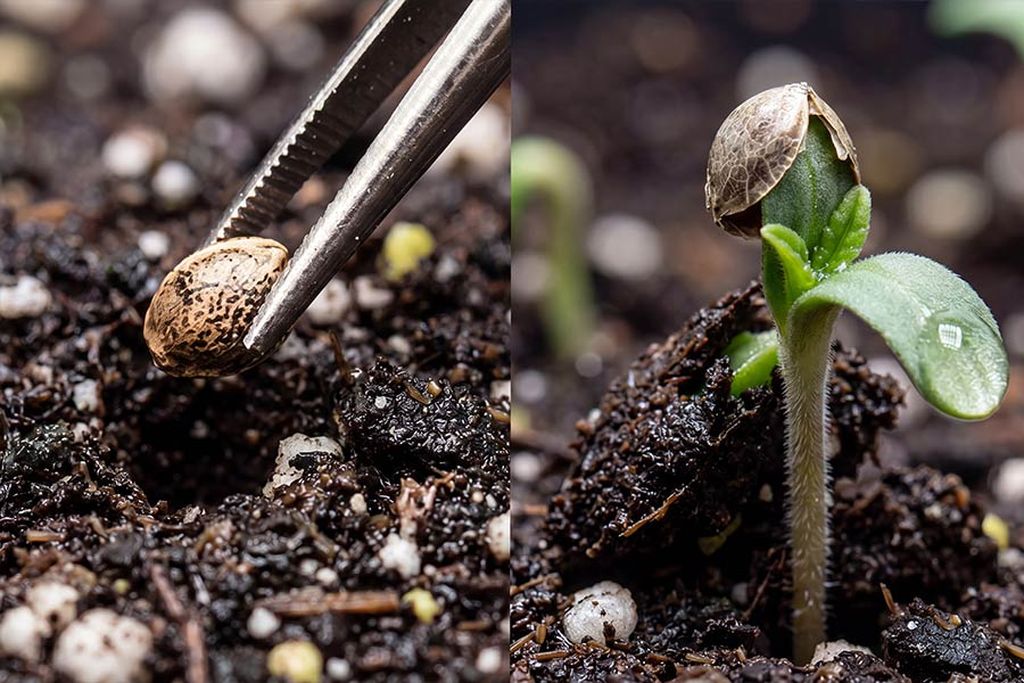
Germinating cannabis seeds directly in soil puts each seed where it'll stay, skipping the transplant step entirely. You won't be able to see what's happening underground, but there's no handling risk once the seed is in place. Most seeds emerge through the soil surface within 5 to 10 days.
Step 1. Fill a small pot with a light, airy seedling soil mix. Moisten it with a spray bottle until the soil feels evenly damp but doesn't clump in a wet ball.
Step 2. Push a small hole in the center of the soil about half an inch deep.
Step 3. Place your seed in the hole with the taproot facing down if one is already visible. Cover it lightly with soil without pressing down.
Step 4. Set the pot in a warm, dark spot and keep the soil lightly moist with daily sprays. Don't soak the surface.
Step 5. Optionally, cut the bottom off a clear plastic bottle and place it over the planting site as a simple humidity dome. Remove the dome as soon as a sprout pushes through.
Step 6. Expect the seedling to break through the surface within 5 to 10 days.
What Can Go Wrong with Soil Germination?
Overwatering is the most common soil germination mistake because saturated soil blocks the oxygen seeds need to sprout. Planting too deep and cold soil are two other common culprits.
Overwatering. The soil should feel moist, not wet. If water pools on the surface or the soil sticks in a wet clump, it's too wet. Let it dry slightly between misting sessions before you spray again.
Planting too deep. More than an inch below the surface makes it hard for the seedling to reach the light. Stick to the half-inch target.
Cold soil. Soil temperatures below 65°F significantly slows germination. A seedling heat mat placed under the pot helps maintain warmth without overheating the roots.
Other Ways to Germinate Cannabis Seeds
Jiffy pellets and rockwool cubes offer a controlled germination environment without needing paper towels or a glass of water. Both are worth adding to your knowledge base.
Jiffy Pellets
Jiffy pellets are compressed peat discs that expand into small grow plugs when soaked in warm water. Once expanded, press a small hole in the center of each pellet, drop a seed in and cover it lightly. Place the pellets on a tray in a dark, warm area and keep them moist but not dripping. Seedlings typically emerge within 3 to 7 days.
Rockwool Cubes
Rockwool cubes are popular in hydroponic setups because they hold moisture evenly and stay sterile. Before using them, soak the cubes in pH-adjusted water with a target pH of 5.5 to 6.0 for at least 30 minutes.
Place a seed in the pre-made hole in each cube and store it in a dark, warm location. Rockwool retains water well, so let the surface dry slightly between misting sessions to keep oxygen available for the emerging root.
How Long Does it Take for Cannabis Seeds to Germinate?
Most cannabis seeds show a taproot within 48 to 72 hours when temperature, moisture and oxygen levels are all in range. But some seeds can take up to 7 days. Older seeds and thick-shelled genetics often need more time, especially if they haven't been pre-soaked.
Temperature has the biggest effect on germination speed. Seeds kept at 70 to 80°F (21 to 26°C) move through the process efficiently. With temps below 65°F, enzyme activity drops sharply and germination can stall.
Moisture is the second key variable. The paper towel or soil should stay consistently damp throughout. Oversaturated media block the oxygen seeds need during germination, which can cause them to rot before sprouting.
Seed age also plays a role. Fresh marijuana seeds from a recent batch typically pop faster than seeds stored for over a year. Older pot seeds can still germinate but may need the full 7-day window and benefit from a 24-hour water pre-soak first.
Germination ends when the taproot has emerged from the shell and the seedling starts pushing toward the surface. Once the first seed leaves, called cotyledons, open above the soil, the seedling stage has begun.
How to Plant Cannabis Seeds After Germination
Once your seeds show a white taproot, it's time to transfer them to your growing medium. The root should be about half an inch long before you move it. Beyond an inch, the taproot becomes fragile and much more vulnerable to handling damage.
How Deep Do You Plant Cannabis Seeds?
Plant your germinated seed about a quarter of an inch (5mm) deep. That puts the shell just below the surface and gives the seedling a short, clear path to the light.
Going deeper than half an inch works against you, particularly in denser soils. Whether you're using soil, coco coir or another loose growing medium, keep it shallow. Outdoors, the same depth applies regardless of soil type.
How to Handle Germinated Seeds Without Damaging Them
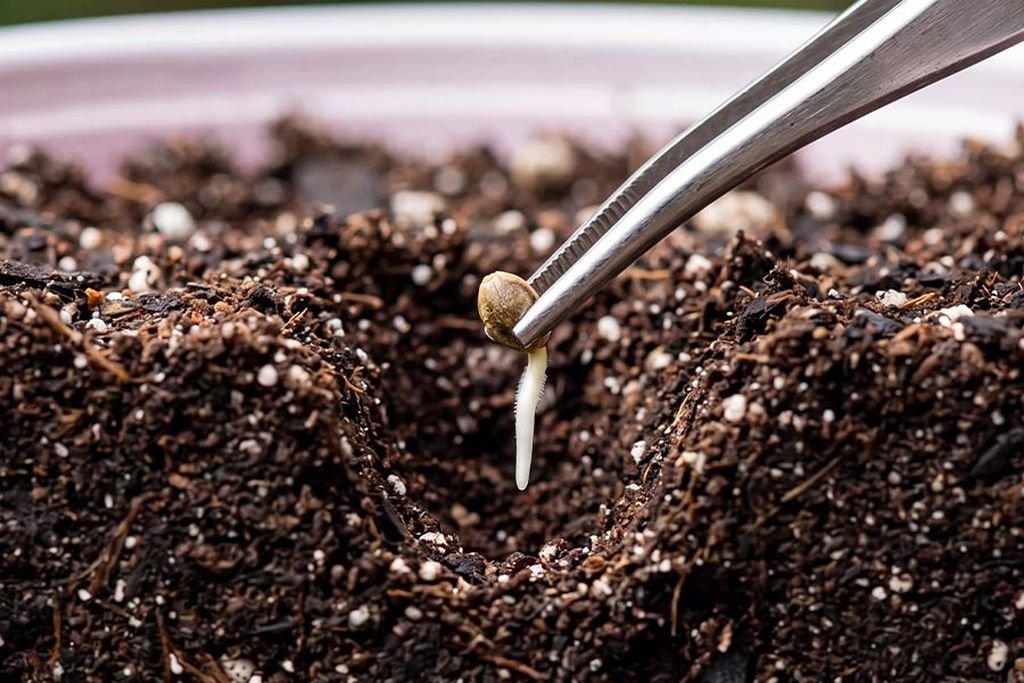
Germinated seeds are at their most fragile the moment the taproot emerges from the shell. Use sterile tweezers to pick each seed up by the shell, not the root. Even light pressure on the taproot can cause damage that affects early root development.
Lower each seed into its hole with the taproot pointing straight down. The root grows downward naturally, so correct orientation gives it a clear path. Cover the seed lightly with soil or growing medium and mist the area around it.
Don't press down on top of the seed and don't soak the medium.
Tips for Cannabis Seeds That Won't Germinate
Not all cannabis seeds pop on schedule, and that's usually not a reason to panic. Most delays come down to temperature or moisture issues rather than bad seeds. Check your setup before writing a seed off. Here are a few tips:
Give it more time. Cannabis seeds that haven't popped after 72 hours may just need a few more days. Keep temperature and moisture consistent and check every 24 hours for up to 7 days before giving up.
Try scarification. Gently scuff the outer shell of a stubborn seed with fine-grit sandpaper to help water penetrate the coat. This works particularly well for older seeds with a hardened exterior.
Add hydrogen peroxide to the soak. Adding a small amount of 3% hydrogen peroxide to your soaking water kills surface mold and bacteria that can block water from reaching the seed inside. Soak for up to 24 hours before moving the seed to the paper towel.
Combine methods. Soaking seeds in water for 24 hours and then moving them to the paper towel often gets results when one approach alone hasn't worked.
If your seeds still haven't popped after 7 days, find out what to do when cannabis seeds won't germinate for more in-depth guidance.
FAQs About Germinating Cannabis Seeds
What is the Best Method for Germinating Marijuana Seeds?
The paper towel method is the most reliable germination technique for most growers because it lets you monitor taproot progress before transplanting. If your seeds need extra help, combine the 24-hour water soak with the paper towel method for a higher success rate. Both methods work across fresh and older genetics.
Should You Germinate Marijuana Seeds in Light or Darkness?
Darkness is the right environment for germinating marijuana seeds. It mimics underground conditions, keeps moisture more stable and limits temperature swings that can slow the process. A closed cupboard or covered container works well for any of the methods in this guide.
Can You Put Marijuana Seeds Straight into the Dirt?
Yes, you can germinate marijuana seeds directly in soil and it's a valid method. It eliminates the transplant step entirely. The trade-off is that you can't monitor the taproot, and overwatering is easier to do accidentally when germinating underground.
What Temperature Do Cannabis Seeds Need to Germinate?
Cannabis seeds germinate best between temperatures of 70 and 80°F (21 to 26°C). Below 65°F, enzyme activity slows and germination becomes unreliable. Above 85°F, conditions start to work against you and the embryo inside the seed can be damaged before the taproot ever emerges.
Does it Matter How Wet the Paper Towel is?
Yes, moisture level is one of the most important variables in the paper towel method. The towel should feel damp when pressed but shouldn't drip or leave any water on your fingers. Seeds need oxygen to germinate, and standing water cuts off that supply.
Can All Cannabis Seeds Be Germinated in a Paper Towel?
Yes, the paper towel method works for all cannabis seed types. Older or thick-shelled marijuana seeds may need a 24-hour water pre-soak first to soften the shell before you move them to the towel. Autoflower seeds, feminized seeds and regular seeds all respond well to the same process.
How Do You Know When a Cannabis Seed Has Germinated?
A cannabis seed has germinated when you can see a white taproot emerging from the cracked shell. That's the radicle, the first root the plant sends out. Transfer the seed to your growing medium once the taproot reaches about half an inch.
Is it Better to Germinate Weed Seeds in Soil or Paper Towel?
The paper towel method gives you more visibility and control because you can see when the taproot appears. Direct soil germination eliminates transplant handling, which suits growers who want to minimize contact with the seed after planting. For beginners, the paper towel method is the more forgiving option because you can spot problems right away.

Gabriel ILGM
Gab Wulff is an ecologist and designer linking sustainability, community gardening, and cannabis reform.

Continue Reading
You might also find these interesting.