
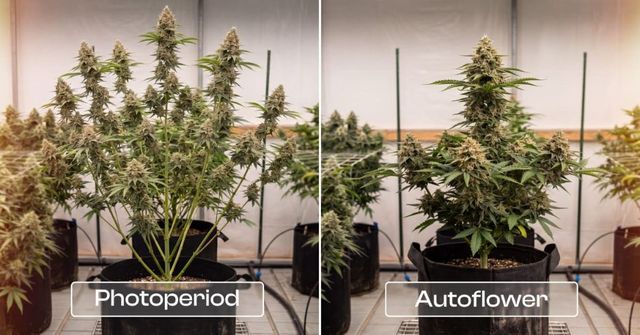
Photoperiod vs Autoflower Seeds Explained: A Complete Comparison Guide
If you're trying to decide between photoperiod vs autoflower cannabis seeds, you're already asking the right question. Both types produce high-quality buds, but auto vs photo weed grows on a very different timeline and suits a different setup.
Photoperiod plants give you control over plant size and flowering timing. Autoflowering seeds deliver a faster, simpler grow that doesn't require a light schedule change.
This guide covers how each seed type works, how they compare on yield and potency, what the harvest timeline looks like and how to decide which one fits your grow plan.

Gabriel ILGM
Table of contents
What's the Difference Between Photoperiod and Autoflower?
The main difference between photoperiod and autoflowering cannabis is how each plant type triggers its flowering stage.
Photoperiod plants flower when their light cycle drops to 12 hours of light and 12 hours of dark. Autoflowering plants flower automatically after 3 to 4 weeks of vegetative growth, regardless of light schedule.
That core difference shapes everything else about how you grow each type. Photoperiod plants need you to control — or wait on — the light. Autoflowering plants handle the timing entirely on their own.
How Photoperiod Cannabis Plants Work
Photoperiod cannabis plants flower when their light cycle shifts to 12 hours of light and 12 hours of dark. The term "photoperiod" refers to this light-dependent behavior. Outdoors, the shorter days of fall trigger flowering naturally. Indoors, you set a timer to flip your grow light to a 12/12 schedule.
Light Requirements for Photoperiod Plants
Photoperiod plants stay in the vegetative stage as long as they receive around 18 hours of light per day. During veg, they focus on building roots, stems and leaves rather than producing buds.
To trigger flowering indoors, you reduce the schedule to 12 hours of light and 12 hours of dark to simulate the shorter days of late summer. Outdoors, the seasonal shift does the work as days shorten in fall.
Photoperiod Growth Timeline and Harvest Window
Photoperiod plants typically take 12 to 20 weeks from seed to harvest, depending on how long you keep them in veg. The vegetative stage is grower-controlled, so you can run it for 4 weeks or 12 weeks depending on how large you want the plant to grow.
Flowering adds 8 to 12 weeks on top, depending on the strain. That extended timeline is one reason photoperiod plants can reach larger sizes and produce bigger yields per plant.
Outdoors in the continental US, flowering is triggered by shortening days in late summer, usually late July to August (depending on latitude). Most indica varieties are ready to harvest in September to October. Sativa strains in warmer climates can run into November.
How Autoflowering Cannabis Plants Work
Autoflowering cannabis plants flower automatically after around 3 to 4 weeks of vegetative growth, regardless of light cycles. You don't need to change a timer or wait for the seasons.
Just keep the plants healthy and they'll move from veg to flower on their own schedule. If you want to explore your options, autoflowering seeds cover a wide range of genetics built for this style of grow.
Why Don't Autoflowering Plants Need a Light Change?
Autoflowering plants don't need a light change because they carry ruderalis genetics, a cannabis subtype with a built-in flowering clock. Cannabis ruderalis evolved in the Volga River region of the Russian Ural Mountains, a cold northern climate. With this naturally short growing season, ruderalis developed the ability to flower by age rather than by light duration.
Modern autoflowering seeds are produced by crossing ruderalis with high-performing indica or sativa strains. The result is a plant that keeps the ruderalis time clock but delivers far higher potency and yield than ruderalis genetics alone.
Autoflower Growth Timeline and Harvest Window
Autoflowering plants typically go from seed to harvest in 7 to 12 weeks, depending on the strain (with some varieties taking up to 14 weeks). This compact timeline makes autos one of the fastest options available to home growers with a short, fixed veg period of 3 to 4 weeks, followed by 5 to 8+ weeks of flowering.
The timeline is largely set at the genetic level, so you can plan your harvest date from the day you germinate (where lawful, of course.) The predictable schedule makes autos a popular choice for growers who want multiple runs in a single season.
Photoperiod vs Autoflower: Side-by-Side Comparison
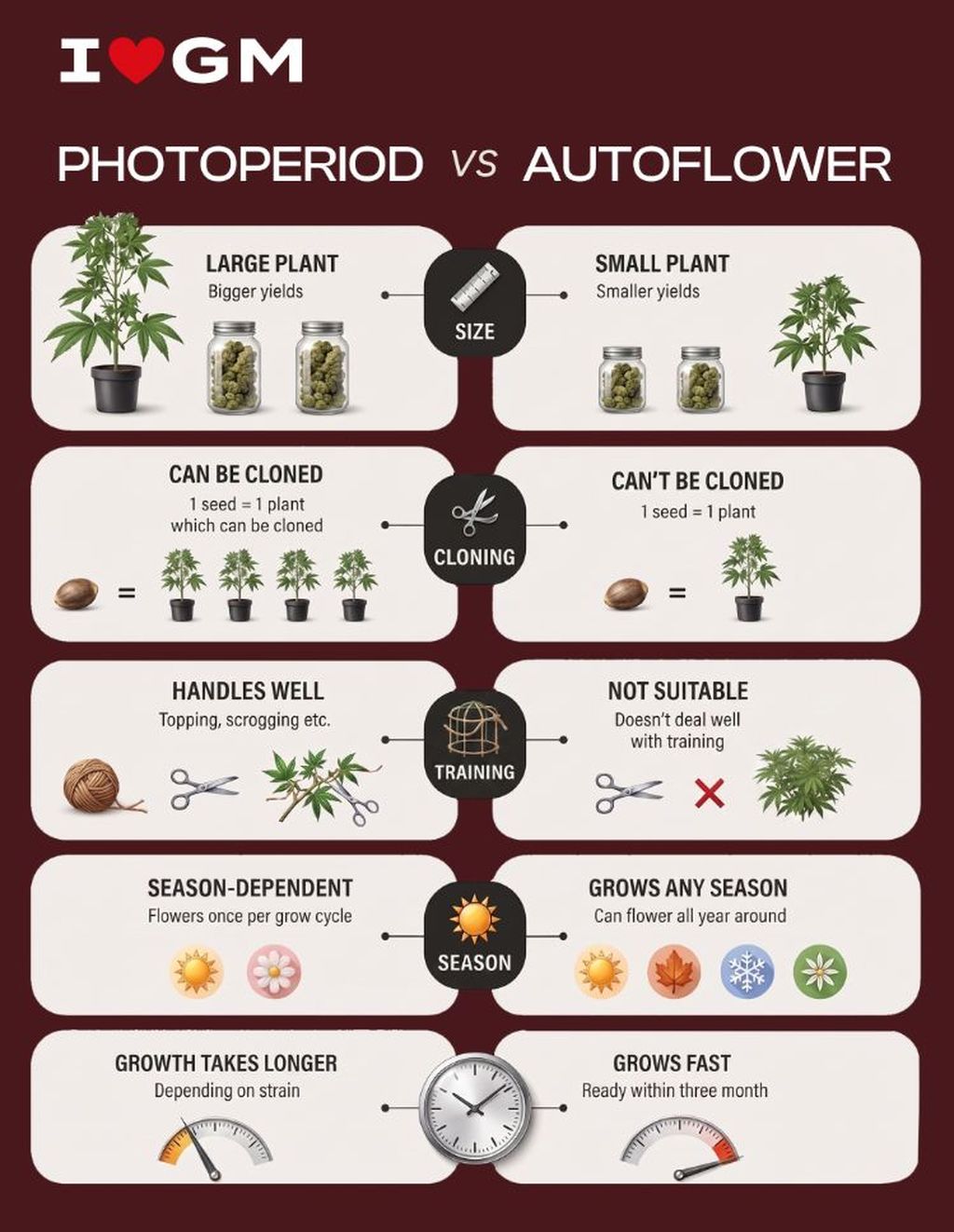
Here's how photoperiod and autoflowering cannabis seeds compare across the six factors that matter most when you're choosing between them.
Grow time is where autos win outright. Autoflowers finish in 7 to 12 weeks from seed. Photoperiod plants run 12 to 20 weeks depending on the strain and how long you veg them.
Yield potential tilts toward photoperiod. Optimized indoor photoperiod grows can push 500+ g/m². Autos typically land between 100 and 400 g/m², with premium autoflower genetics closing that gap in recent years.
Potency is a draw. Both seed types reach 20 to 30%+ THC with the right genetics. The ceiling is set by the strain, not the seed type.
Ease of growing favors autos. No light schedule change is needed — they flower on their own internal timer. Photoperiod plants require a deliberate flip to 12/12 to trigger flowering.
Cloning and training separate them further. Photoperiod plants clone reliably and respond well to both high-stress and low-stress training. Autoflowers don't clone practically and suit low-stress training only.
Photoperiod vs Autoflower Yields
Photoperiod seeds produce higher yields per plant than autoflowering seeds because photoperiod plants spend more time developing in the vegetative stage. A photoperiod plant kept in veg for 8 to 10 weeks builds a dense root structure and wide canopy.
That mass translates directly to yield potential at harvest. Indoors, well-grown photoperiod plants can produce up to 500 grams per square meter or more, depending on the strain and grow setup.
Autoflowering weed seeds produce smaller yields per plant because the fixed veg period limits how large the plant can grow before it flowers.
That gap closes quickly in a sea of green (SOG) setup, where a high density of auto plants can approach the g/m² output of a photoperiod run. Outdoors, autoflowers can produce multiple harvests per season, while a photoperiod plant typically delivers one.
Which is More Potent: Photoperiod or Autoflower?
Autoflowering strains reach THC levels equal to photoperiod varieties. Photoperiod cannabis seeds used to hold the potency advantage, but modern autoflowering genetics have closed that gap entirely.
Autoflowering marijuana seeds have come a long way since early ruderalis crosses, which often tested below 15% THC. Today, you can find both autoflowering and photoperiod strains in the 20 to 30% THC range. If potency is the priority, our range of high THC seeds includes both photoperiod and autoflowering options.
Can Autoflowering Plants Be Male?
Yes, autoflowering plants can be male if you're growing regular (non-feminized) autoflowering seeds. Regular autoflowering weed seeds carry the same approximately 50% male probability as regular photoperiod seeds.
Male autoflowering plants produce pollen sacs — balls that release pollen and can pollinate nearby female plants if not removed in time. A pollinated female spends her energy producing seeds rather than resinous buds.
To remove that risk, feminized cannabis seeds (including feminized autoflower varieties) are bred to produce female plants almost every time. Most autoflowering seeds sold today are feminized, so male plants are rarely an issue for buyers who check the product type before purchasing.
If you're growing regular autoflowering seeds for breeding purposes, sex the plants early and pull any males before pollen drops.
Photoperiod or Autoflower: Which Should You Grow?
The right choice between photoperiod and autoflowering seeds depends on your grow space, experience level and what you want from the harvest. Neither type is objectively better. They solve different problems for different growers.
Choose autoflowering seeds if:
You have limited space or a short outdoor season.
You want a predictable, fast harvest with minimal setup.
You're a first-time grower who doesn't want to manage a light schedule.
You want to run multiple harvests per year.
Choose photoperiod seeds if:
You want maximum yield per plant.
You want full control over plant size and flowering timing.
You plan to clone plants or run a mother plant.
You’re an experienced grower who wants to use high-stress training methods.
For growers just getting started, our cannabis seeds for beginners page covers options from both types matched to first-time grow setups. If you've already decided on photoperiod, explore some of the best photoperiod strains to narrow down the right fit.
Whatever you choose, you'll find both types in our full catalog of cannabis seeds from trusted breeders, for eligible adult buyers where cultivation is permitted by law.
FAQs About Photoperiod vs Autoflower Marijuana Seeds
How Long Do Photoperiod Plants Take From Seed to Harvest?
Photoperiod plants take 12 to 20 weeks from seed to harvest. The exact time depends on how long you keep them in the vegetative stage and the flowering time of the specific strain. Most photoperiod strains add 8 to 12 weeks of flowering after the light switches to 12/12.
Can You Clone Autoflowering Plants?
No, autoflowering plants can't be cloned effectively. An autoflowering clone shares the same internal clock as its mother plant, so it flowers and finishes at the same time with very little time to develop. Photoperiod plants are the right choice if cloning is part of your grow plan.
Do Autoflowers Need a 12/12 Light Schedule to Flower?
No, autoflowering plants don't need a 12/12 light schedule to flower. They flower based on age, not light cycle. Autoflowers do best under 18 to 24 hours of light and don’t need a dark period. Most growers run an 18/6 schedule (18 hours on, 6 hours off) from seed to harvest, though some push to 20 or more hours to maximize growth rate and final yield.

Gabriel ILGM
Gab Wulff is an ecologist and designer linking sustainability, community gardening, and cannabis reform.