
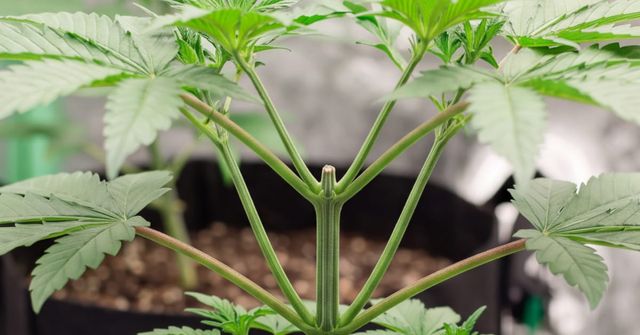
When to Top Autoflowers: The Complete Guide
Knowing when to top autoflowers is one of the most important timing calls you'll make in the grow room. Topping autoflowers the right way builds a bushier, higher-yielding plant. Do it too late or incorrectly though, and you risk a plant that stalls before it hits full size.
Both outcomes come down to a narrow vegetative window that most growers either nail or miss.
This guide covers the exact timing, the correct topping method, plant care tips and when topping your autoflowering cannabis plants is worth a skip.

Gabriel ILGM
Table of contents
Can You Top Autoflowering Cannabis Plants?
Yes, you can top autoflowering cannabis plants, but only during a short window before flowering starts.
Topping cuts the main growing tip to split the plant's energy into two new colas. It works on autos just like it does on photoperiod plants. The difference is recovery time.
Photoperiod plants stay in veg as long as you keep the light schedule going. You can top them, wait for recovery and keep training without a deadline. Autoflowering cannabis plants move from seed to flower on their own internal clock. Most start the flowering transition in weeks 3 to 4, no matter what you do.
That tight timeline is what makes topping autos a calculated risk. Get the timing right and the plant recovers fast and builds multiple colas. Miss it and you risk a stunted plant that never hits full size.
Not every grower who shops for cannabis seeds plans on training their plants. But if you understand the window, you can make the call with confidence.
Should You Top Your Autoflowering Plants?
Yes, if your autoflowering marijuana plant meets a few specific criteria, topping is worth trying.
The challenge is that autoflowering plants don't give you much room for error. Plant health, node count, growth rate and your experience all affect whether the cut helps.
Check these six conditions before you make the cut:
Plant health: Your plant should be green, vigorous and upright. Drooping, pale or stressed plants aren't ready.
Node count: 4 to 5 nodes is the sweet spot. Under 3 means it's too early; past 5means you've likely missed the window.
Flowering signs: No white pistils should be visible anywhere on the plant. Hair at the nodes means flowering has started and topping will do more harm than good.
Week of growth: Week 3 is the target. The end of week 4 or later is too late for most autoflower genetics.
Daily growth rate: The plant should be pushing new growth every day. Slow or stalled development is a signal to hold off.
Experience level: At least one successful autoflower harvest under your belt makes this a much lower-risk decision. First-time growers are better off starting with LST.
If most conditions check out, your plant's ready. If even one red flag shows up, LST is the safer call.
When Topping Autoflowers Makes Sense
Topping autoflowers makes sense when the plant is healthy, growing fast and at 4 to 5 nodes.
Look for new growth pushing out every single day. The plant's color should be deep green, the stem firm and the nodes symmetrical. That kind of vigor means the plant has the energy to recover from a cut.
It helps to have at least one prior auto grow behind you before you try topping. Reading a plant's recovery signals takes experience. If you're still building that experience, look for autoflowering strains with longer life cycles. They give you a slightly wider topping window to work with.
Longer-cycle strains with sativa-leaning genetics also handle topping better. These cultivars often run 11 to 14 weeks from seed to harvest. That extra time makes recovery less stressful for the plant.
When to Avoid Topping Autoflowers
Topping autoflowers carries the most risk when the plant is slow-growing, stressed or already showing pre-flower signs.
A plant that's drooping, pale or growing slowly doesn't have the energy to handle a cut. Topping it at that point usually makes things worse.
White pistils at the nodes are a hard stop. Those fine white hairs signal that pre-flower has already started. Cutting after that point disrupts the flowering transition and commonly results in a smaller final plant and diminished yield potential.
If this is your first auto grow, skip topping entirely this run. Low-stress training (LST) is more forgiving and still opens up the canopy without the recovery risk. When you're ready to level up, cannabis seeds for beginners are a good starting point for building grow experience. Get a grow or two under your belt before attempting topping.
When to Top Autoflowering Cannabis Plants
Autoflowering cannabis plants have a narrow topping window between week 3 and the first signs of pre-flower.
Most autos spend just 3 to 4 weeks in veg before the clock flips. You need to hit the topping window inside that span. Hit it right and the plant bounces back without losing momentum. Miss it and recovery eats into flowering time.
Here's what the three sections below cover:
How Many Nodes: The minimum node count that confirms your plant has enough vegetative mass to handle a cut.
What Week: Why week 3 is the most reliable timing target for most autoflowering strains.
Too Late Signals: The visual cue that tells you the window has closed for good.
How Many Nodes Should An Auto Plant Have Before Topping?
Autoflowers need at least 4 to 5 nodes before topping is safe.
Nodes are the points along the stem where leaf pairs emerge. Count from the base of the plant up. The first pair is usually small and underdeveloped. Nodes 4 and 5 are the target.
At 4 to 5 nodes, the plant has enough vegetative mass to survive the cut. Under 3 nodes means the root system isn't strong enough yet. Past 5 nodes, you're approaching the edge of the safe window.
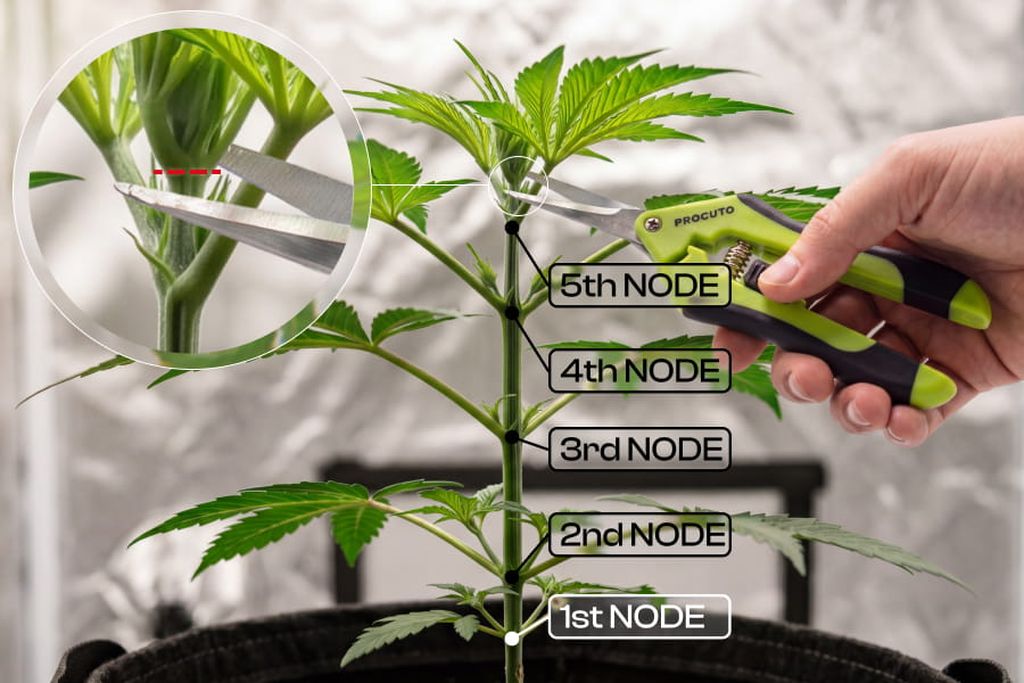
A fast-growing auto can hit 5 nodes in as little as 18 to 21 days. A slower plant might take 25 days or more to get there. Use node count, not the calendar date, as your primary readiness signal.
What Week Should You Top Autoflowers?
Week 3 is the most reliable topping window for autoflowering cannabis plants growing at a healthy rate.
Most strains reach their 4th or 5th node around day 18 to 21. That puts the ideal cut right in the middle of week 3 for a vigorous plant.
Fast-finishing strains can move into pre-flower by day 21, so don't assume you have all of week 3. Check for pistils every few days starting on day 18 if your strain has a short cycle.
Sativa-leaning autos with longer life cycles can sometimes allow topping into early week 4. But week 3 is the baseline. Past day 28, it's usually better to skip topping and work with LST instead.
When is it Too Late to Top Autoflowers?
Topping autoflowers becomes too risky once the first white pistils appear at the nodes.
White pistils are fine, hair-like structures that emerge from the node joints. They signal the start of pre-flower and the beginning of the flowering transition. Once you see them, the plant is preparing to bloom.
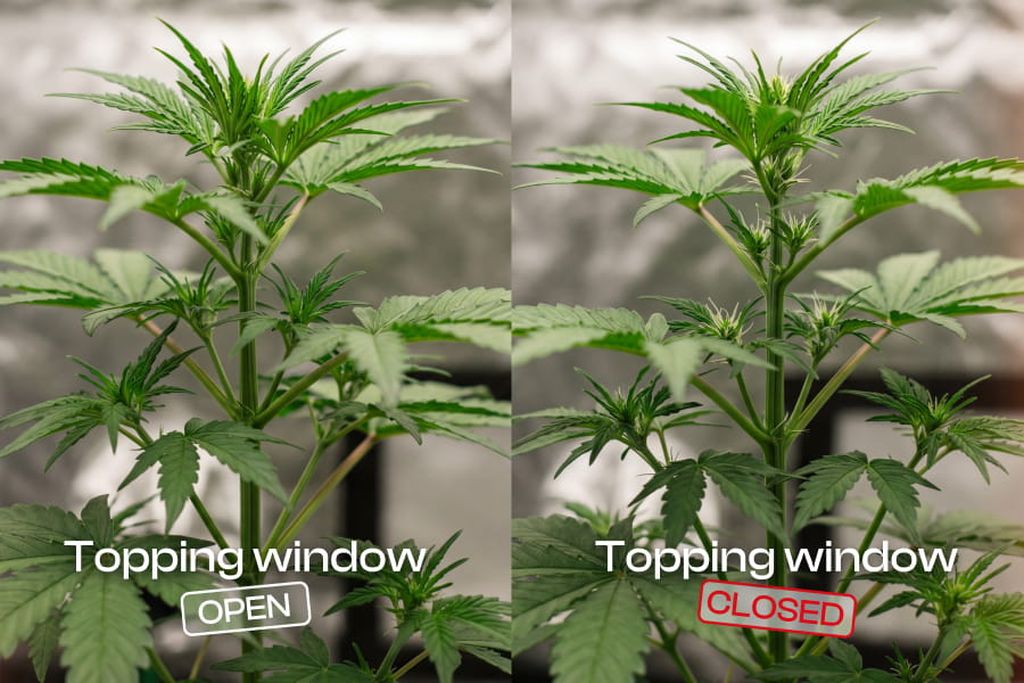
Plants topped after pistils appear often stall. They use energy that should go into early flower development to recover from the cut. The result is usually a smaller, less productive plant.
If you've passed the window, you're not out of options. LST is still viable. Bending and tying branches doesn't create the same recovery demand and still improves light distribution across the canopy.
How to Top Autoflowering Cannabis Plants
Topping autoflowering cannabis plants requires a clean cut above node 3. Use sterilized scissors or a sharp razor blade for the job.
The method itself is simple if your plant is ready. The three sections below cover what to prep, where to cut and how to handle recovery.
What You Need: The tools and plant condition checks to confirm before you make the cut.
Where to Cut: The exact position above node 3 and what removing the tip does for canopy structure.
After Topping: The recovery conditions that determine whether your plant bounces back on schedule.
What You Need Before Topping Autoflowers
Before topping autoflowers, you need sterilized scissors or a sharp razor blade and a plant that's ready.
A ready plant is at 4 to 5 nodes with no white pistils at the nodes. It should be showing new growth every day and looking a healthy, deep green.
Sterilize your scissors or blade before the cut. Wipe them down with isopropyl alcohol and let them dry. A contaminated blade can introduce pathogens to the open cut site. Autoflowering plants don't have extra weeks of veg growth to fight off an infection.
Don't combine topping with other high-stress techniques in the same session. Too much stress at once slows recovery or stalls it entirely.
Where to Cut When Topping Autoflowers
When topping autoflowers, cut just above node 3 to remove the growing tip and trigger two new growth shoots.
The growing tip is the topmost part of the main stem, the part actively pushing upward. Removing it stops the plant from directing all its energy into a single central cola. The two side shoots immediately below the cut take over as your new main colas.
Position your scissors just above node 3 and make one clean, confident snip. Don't saw or twist. Remove as little plant material as possible.
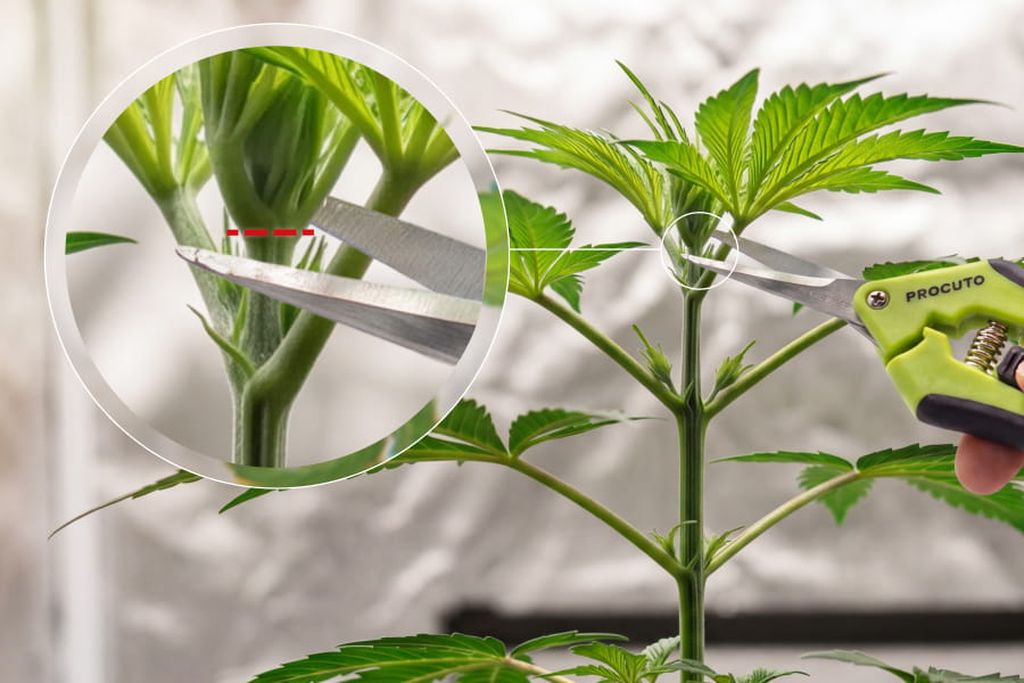
The cut site seals over within 24 to 48 hours in a healthy plant. You'll know recovery is underway when two new shoots start pushing out from the nodes below.
How to Care for Autoflowers After Topping
After topping autoflowers, keep conditions stable and avoid additional high-stress techniques during the 3 to 5 day recovery window.
Your plant doesn't need anything unusual after the cut. It needs consistency. Keep the temperature steady, maintain your normal watering schedule and don't adjust nutrients drastically.
Watch for two new growth tips pushing out within 24 to 48 hours. That's your confirmation the recovery is on track. If the plant looks healthy and the new shoots are developing, you're good to go.
If nothing is happening by day 5, check your environment. Temperature swings, overwatering and light stress are the most common causes of a slow recovery.
Once the new shoots are established, you can add LST to open the canopy further. Growers chasing the highest yielding seeds should pair good topping timing with stable post-cut conditions. That combination does more for yield than either factor alone.
Topping Autoflowers vs. LST: Which is Right for You?
Topping autoflowers and LST both reshape the canopy, but they differ in stress level, recovery time and risk profile. Here's how they compare across the factors that matter most:
Stress level: Topping is high-stress — it involves a cut and creates a recovery demand. LST is low-stress, bending and tying branches without removing anything.
Recovery time: Expect 3 to 5 days of recovery after topping. LST carries near-zero recovery cost and doesn't pause the plant's momentum.
Timing window: Topping has a narrow window — week 3, or early week 4 for longer-cycle strains. LST is flexible throughout the vegetative phase.
Skill required: Topping suits growers with at least one autoflower harvest behind them. LST is beginner-accessible from the first grow.
Yield potential: Both techniques can deliver high yields. Topping matches LST on upside — but only when timed correctly.
Risk of stunting: Topping carries moderate to high risk if the plant isn't ready. LST keeps that risk very low regardless of timing.
Both techniques can increase yield and improve canopy coverage.
The difference is risk.
If you're new to growing autos or not sure your plant is ready, LST is the safer choice.
For growers who want more training flexibility, photoperiod seeds offer a longer vegetative window. You can top, wait for full recovery and train further without a flowering deadline.
Feminized cannabis seeds grown on a photoperiod schedule give you that extended veg time to work with while ensuring every plant is a bud-producing female. You can also find high THC seeds across both photoperiod and autoflowering categories.
If you're sticking with autos, look for strains with longer life cycles. Browse autoflowering seeds to find options that match your training goals. Always check federal, state and local laws before buying or germinating any cannabis seeds.
FAQs About Topping Autoflowers
Can All Autoflower Strains Be Topped?
No, not all autoflower strains handle topping equally. Strains with longer life cycles (11 weeks or more) recover more reliably. There's more vegetative time available before the plant moves into flower. Fast-finishing strains that complete in 8 to 9 weeks from seed carry a higher risk of stunting. Research your strain's average life cycle before you decide.
Does Topping Autoflowers Delay Harvest?
It can push harvest back by a few days in a healthy, fast-recovering plant. If the plant recovers within the standard 3 to 5 day window, the overall timeline is minimally affected. A stunted plant is a different story. Stunting from late or poorly timed topping can push harvest back significantly. Plant health matters more than the technique itself.
Can You Top Autoflowers Twice?
No, it's not recommended to top autoflowers twice. A single topping already pushes the limits of an autoflower's short vegetative window. A second cut rarely leaves enough time to recover before flowering begins. If you want multiple colas after the first top, use LST to train the two new shoots. Bending and tying them outward achieves a wide canopy without adding more cut-related stress.
What's the Difference Between Topping and Fimming Autoflowers?
Topping removes the entire growing tip and creates two new main colas. Fimming removes only part of the growing tip and can produce up to four new growth points. The results from fimming are less predictable. Both are high-stress techniques with similar timing requirements for autoflowering plants. If you're just starting with HST on autos, topping is cleaner and easier to execute consistently.

Gabriel ILGM
Gab Wulff is an ecologist and designer linking sustainability, community gardening, and cannabis reform.