
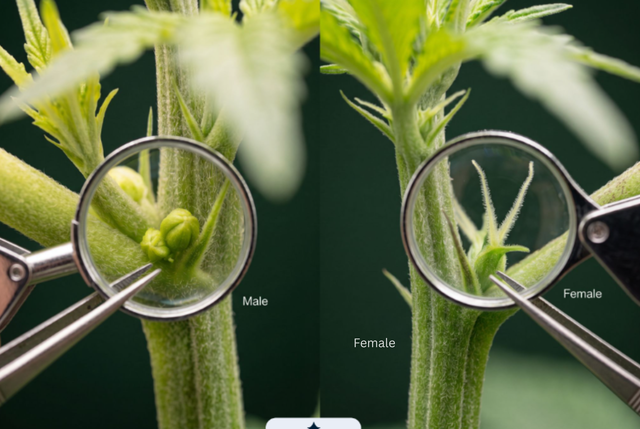
Male vs Female Weed Plant: How to Tell the Difference
Male and female weed plants differ in one way that matters most to growers: female cannabis plants grow the buds people consume, and male cannabis plants grow pollen sacs that seed those buds instead.
This guide shows you how to sex cannabis plants by their pre-flowers, what the earliest male and female signs look like and which plant to remove before pollination starts. By the end you will know which signal confirms sex, which signal only hints at it and when to act so your female plants stay seedless.
The short version: Female cannabis plants grow a thin white hair called a pistil from a teardrop calyx at the node. Male plants grow a small round pollen sac instead. Check the upper nodes, roughly the second through fourth set down from the growing tip, once the plant is four to six weeks old. The pre-flower shape confirms sex more reliably than height, leaf shape or any other trait.

Gabriel ILGM
Table of contents
What Is the Difference Between Male and Female Weed Plants?
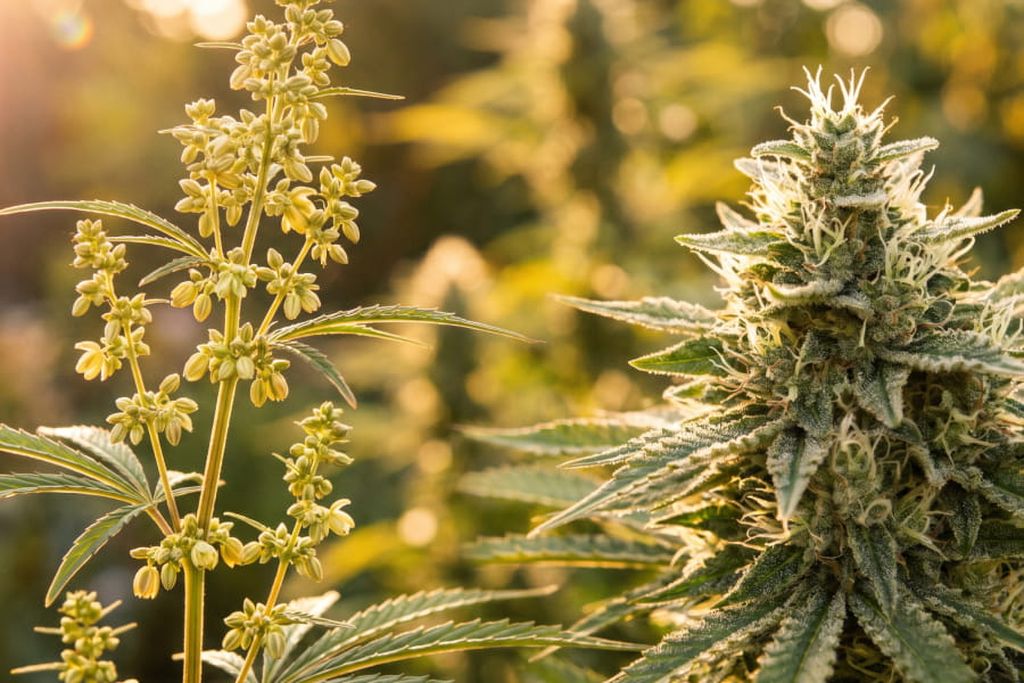
The difference between male and female weed plants is reproductive function, because female cannabis plants produce flower and male cannabis plants produce pollen. Female weed plants grow dense flower clusters coated in resin, and those buds are what growers harvest, dry and consume.
Male pot plants grow clusters of pollen sacs that open and release pollen, which fertilizes nearby females and turns their buds into seeds. Most growers keep only female plants because an unpollinated female plant produces seedless flower, known as sinsemilla.
This section breaks the comparison into the signals that matter:
Pre-flower shape carries the highest reliability and confirms sex on its own.
Timing of first signs tells you when each sex usually reveals itself.
Plant structure offers a weak early clue but never confirms sex alone.
How Do Female Weed Plants Look?
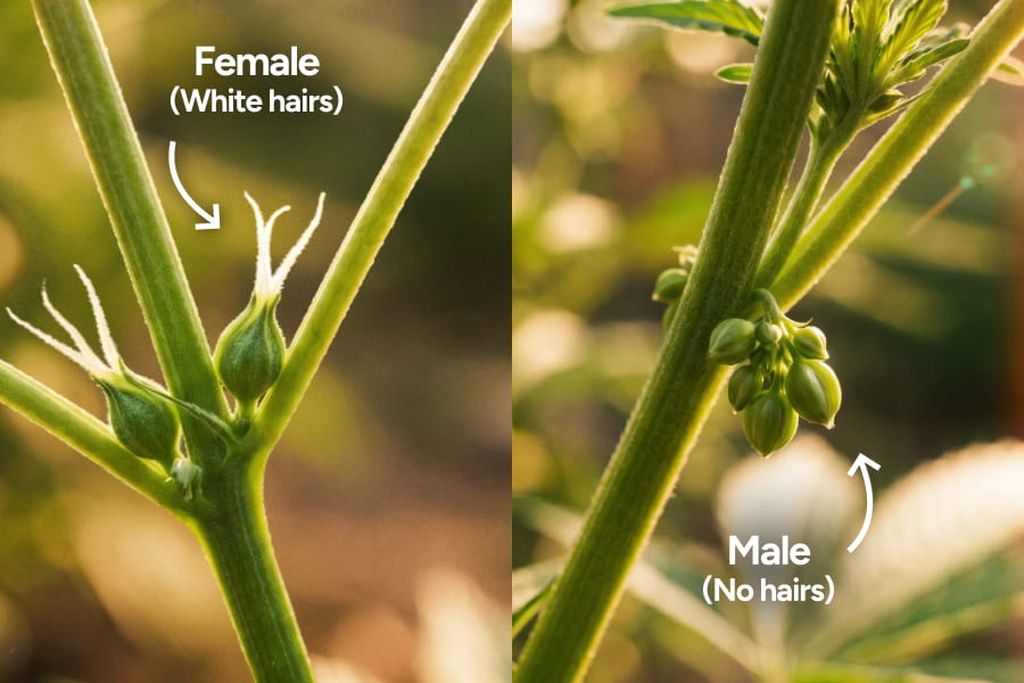
Female weed plants reveal themselves through pistils, which are thin white or cream hairs that emerge in pairs from a small calyx at the node. The calyx is a teardrop-shaped pod, and the two hairs poke out of its tip where a branch meets the main stem. As the female cannabis plant matures, these calyxes stack into the flower clusters that thicken into buds.
The pistils start white and darken to orange or amber as the female pot plant ripens toward harvest.
How Do Male Weed Plants Look?
Male weed plants reveal themselves through pollen sacs, which are small round green balls that form in tight clusters at the node. Each sac hangs on a short stalk and looks like a tiny grape or spade before it matures. As the male cannabis plant develops, these sacs swell, split open and shed yellow pollen onto everything below.
A male pot plant shows these balls a few days to a week earlier than females show pistils, so early sacs are often the first sex sign in a grow room.
How to Sex Cannabis Plants by Their Pre-Flowers
Sex cannabis plants by inspecting the nodes for pre-flowers, since pre-flowers appear weeks before full flowering and reveal sex early. A node is the joint where a branch or leaf meets the main stem, and pre-flowers form right in that joint.
Use a magnifying loupe or a phone macro lens, because the earliest pre-flowers are smaller than a grain of rice. Check the same plant every few days from about week four to week six, when most photoperiod cannabis plants commit to a visible sex.
Where to Look on the Cannabis Plant
Look at the upper nodes, about two to four sets of leaves down from the top, because pre-flowers show there first on most cannabis plants. The lower and middle nodes mature before the top, so they reveal sex earlier than the growing tip. Turn the plant so light hits the node joint directly, since the pre-flower tucks tight against the stem.
Inspect several nodes before deciding, and never judge sex from a single unclear node.
Male vs Female Cannabis Plant in Early Stages
Male and female cannabis plants look identical in their early stages, because seedlings and young vegetative plants show no sex signs at all. Sex only becomes visible once pre-flowers form, which happens after roughly four to six weeks of vegetative growth for photoperiod plants.
The first male sign is usually a smooth round bump with no hair, and the first female sign is usually a calyx with one or two thin pistils. A bump alone can be hard to read, so wait for either a clear sac shape or a white hair before you call it.
Which Signals Confirm Sex and Which Only Hint at It
Pre-flower shape confirms sex, and every other trait only hints at it, so weight your observation by signal reliability. Growers often misread plant height, leaf shape or growth speed as sex signals, but those traits track genetics and environment instead.
The signals below are rated by reliability to help you distinguish confirmed indicators from traits that are only suggestive.
Cannabis Sex Identification Signals
Pollen sac at the node
Appearance: Round ball on a short stalk
Points to: Male
Reliability: High
Pistil at the node
Appearance: Thin white hair emerging from a calyx
Points to: Female
Reliability: High
Pre-flower timing
Appearance: Pollen sacs appear several days before pistils
Points to: Male (slightly earlier development)
Reliability: Medium
Plant height
Appearance: Taller, lankier early growth
Points to: Possibly male
Reliability: Low
Leaf or node spacing
Appearance: Wider internode gaps
Points to: No reliable link to plant sex
Reliability: Low
What to Do Once You Confirm a Male Weed Plant
Remove a confirmed male weed plant from the grow space before its pollen sacs open, because open sacs release pollen that seeds every nearby female. Pollen travels on air and clothing, so isolate or discard the male cannabis plant rather than leaving it among females.
Growers who breed cannabis keep select males in a separate sealed space to collect pollen on purpose. Growers who want seedless buds remove every male pot plant the moment its sex is confirmed.
A single missed male can pollinate an entire room.
Why Hermaphrodite Plants Need a Second Look
Hermaphrodite cannabis plants grow both pistils and pollen sacs on the same plant, so they can self-pollinate and seed your crop. Stress from heat, light leaks or interrupted dark periods can push a stressed female to throw a few male sacs, often called hermies. Inspect plants that show mixed structures as carefully as you inspect suspected males.
Remove or isolate a hermaphrodite plant, because even a small number of sacs can produce seeds.
How Seed Type Changes Your Male vs Female Odds
Seed type sets your odds of growing male versus female plants before sexing ever begins, because breeders stabilize sex differently across seed categories.
Regular cannabis seeds carry a natural split close to 50% male and 50% female, so growers expect to sex and cull. Feminized cannabis seeds are bred to grow into female plants virtually every time, which removes most of the sexing and culling work. Autoflower seeds also come feminized in most catalogs, and they reveal sex by age rather than by a change in the light cycle.
Why Feminized Seeds Reduce the Sexing Workload
Feminized cannabis seeds reduce the sexing workload because the seed type is bred to produce female plants almost every time. A grower starting from feminized seeds spends far less time inspecting nodes and removing males, since nearly every plant turns out female.
This certainty keeps the grower's attention on plant care, flowering behavior and harvest planning instead of culling. New growers often start with beginner cannabis seeds for that reason, because predictable female outcomes lower the early learning curve.
Where Autoflower and Regular Seeds Fit
Autoflower seeds shift the sexing window earlier, because age-based flowering means pre-flowers can appear within a few weeks of sprouting. A grower choosing autoflower seeds sees sex signs sooner but has a shorter window to act before flowering locks in.
Regular cannabis seeds keep the natural male-female split, which makes them the right pick for breeders who want both sexes. Most home growers who only want buds choose feminized or autoflower cannabis seeds over regular seeds to skip the cull.
Frequently Asked Questions
How Early Can You Tell If a Weed Plant Is Male or Female?
Pre-flowers reveal sex around four to six weeks of age on photoperiod plants, and a few weeks sooner on autoflowers. Seedlings show no sex signs, so you cannot sex a plant before pre-flowers form at the nodes.
Can You Tell a Plant's Sex From a Seed?
No, you cannot tell a cannabis plant's sex from the seed by sight. Seed size, color and shape track ripeness and storage, not sex. Sex is set by genetics and only becomes visible once pre-flowers form at the nodes.
Do Male Weed Plants Produce Any Buds?
No, male weed plants do not produce consumable buds. Male cannabis plants grow pollen sacs instead of flower, and those sacs hold pollen rather than the resin-coated buds that females produce.
What Happens If a Male Plant Pollinates a Female?
A pollinated female weed plant redirects energy into making seeds instead of swelling buds, so the flower fills with seeds and loses potency and weight. Removing males before their sacs open keeps female plants seedless.

Gabriel ILGM
Gab Wulff is an ecologist and designer linking sustainability, community gardening, and cannabis reform.