
 SUPPORT
 SHIPPING INFO
 STRAIN FINDER

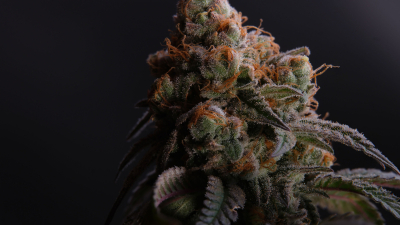
A cannabis bud is a dense cluster of many small female flowers packed together at one site on the plant. Growers call it a bud, dispensary menus call it flower, and plenty of people just call it a nug. All three words point to the same structure, and none of them describe it very precisely.
This guide names every part you can see on a bud, from trichomes and bracts to stigmas, sugar leaves and the colas they build into. It also sorts out the two terms growers use most loosely — calyx and pistil — and then puts the vocabulary to work so you can look at a bud and explain what you’re actually seeing.
What Is a Weed Flower or Bud?
A weed flower, or bud, is a tightly packed cluster of many individual female flowers that grow from a single site on the plant. Botanically, the whole cluster is actually called an inflorescence, a flowering head. Cannabis is dioecious, so an individual plant is typically male or female, and only female plants build this structure.
It doesn’t look like a garden flower because cannabis relies on the wind for pollination. With no insects to attract, the plant skips petals and nectar. Instead, it puts its energy into structures that catch airborne pollen and tissue that shields the flowers behind them.
The Parts of a Marijuana Bud
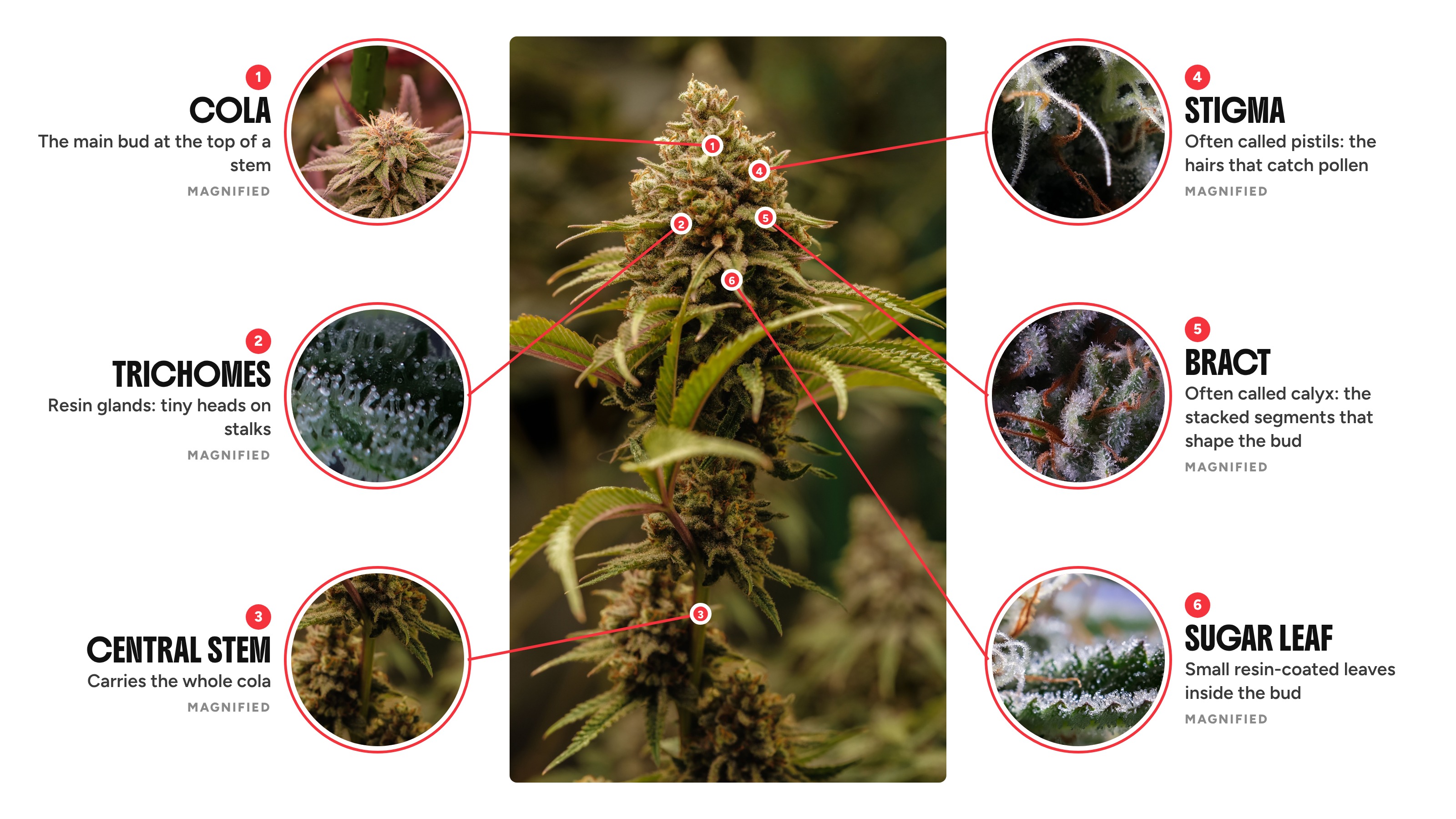
A cannabis bud has four visible parts, and they nest inside one another. Trichomes coat the bracts, bracts wrap around each tiny flower’s reproductive parts, stigmas reach outward from inside the bracts, and sugar leaves push through the gaps between clusters. The sections below work from the smallest structure up to the largest.
Trichomes: The Resin Glands
Trichomes are microscopic resin glands on the surface of a bud, where the plant produces and stores cannabinoids, terpenes, and flavonoids. Cannabis grows three glandular types:
-
Bulbous trichomes: the smallest type, little more than a tiny round head.
-
Capitate-sessile trichomes: a globular head sitting on a very short stalk or almost none at all.
-
Capitate-stalked trichomes: a larger head raised up on a longer stalk.
Capitate-stalked glands produce most of the resin compounds. They develop from smaller sessile-like precursors as a flower matures, which is why a bud looks frostier late in flowering than it did when its first clusters formed.
Coverage is heaviest on bracts, lighter on sugar leaves, and thinner still on other tissue. The resin itself is a defense. It deters insects and buffers the plant against UV and other abiotic stress, and the sticky coating growers prize is a byproduct of that job.
Bracts: The Bud's Building Blocks
Bracts are modified, leaf-like structures only a fraction of an inch across that stack up to give a bud its shape. Each one wraps around a single flower’s reproductive parts, enclosing the ovule, the short style above it, and the base of the stigmas.
Bracts carry the densest trichome coverage anywhere on the plant, and they make up most of the tissue left after trimming. What you hold in your hand is mostly bract. That’s why trimming has such a big effect on a finished bud. The more leaf material you take off, the higher the share of resin-heavy bract left behind.
Bract size and color vary between cultivars, running from green through purple, magenta, red, or blue. You’ll often hear bracts called calyxes, though that name isn’t quite accurate.
Stigmas: The Hairs You See
Stigmas are the fine, hair-like strands that catch pollen drifting through the air, and each female flower pushes out two of them. Their surface is covered in tiny hairs called papillae, which help trap airborne pollen grains as they pass. Stigmas also change color as a flower matures. They start out white and shift through yellow to orange, red, or brown.
Since every small flower adds its own pair, a bud’s hairiness partly reflects how many flowers are packed into it. A tight cluster carries more stigmas than a loose one of the same size.
Most growers call these hairs pistils, a shorthand that only covers part of the structure.
Sugar Leaves: The Small Leaves Inside the Bud
Sugar leaves are the small, narrow leaves that grow out from inside the bud, named for the frosted, sugar-dusted look their trichomes give them. They still photosynthesize, feeding the developing flowers right beside them.
Compared to fan leaves, sugar leaves are smaller and narrower, carry fewer blades, and show visible resin. Fan leaves grow outside the bud and belong to the wider cannabis plant anatomy.
They also host trichomes, though never at the density found on bracts. Most come off during trimming, and how many you remove is a big reason two buds from the same plant can look so different in the jar.
Calyx or Bract? Pistil or Stigma? Getting the Names Right
What growers call a calyx is almost always a bract, and the hairs they call pistils are stigmas. Both names stick because they work fine in everyday grow talk, even though neither is botanically exact.
Cannabis doesn’t have a clearly differentiated calyx like many flowering plants do. It has calyx cells, which sit inside the perianth, a translucent layer of tissue that partly sheathes the ovule. The ovule is where a seed forms if the flower gets pollinated.
The mix-up makes sense. A bract looks a lot like the cup of sepals at the base of a conventional flower, and in most plants that cup is the calyx.
The pistil is the entire female reproductive unit: the two stigmas, the style connecting them downward, and the ovule at the base. Only the stigmas show outside the bract, so the visible tip ended up carrying the name of the whole thing.
In a grow room, using the terms ‘calyx’ and ‘pistil’ won’t confuse anyone. Bract, stigma, and perianth are the terms to use in botanical work, breeding notes, and lab documentation, where the difference between a whole pistil and its visible tip carries real importance.
Common Cannabis Flower Terms and Their Accurate Names
-
Calyx: Often used to describe the small segments that stack up to form the bud. The accurate term is bract.
-
Pistil: Commonly used to describe the fine hairs on the outside of the bud. The accurate term for these hairs is stigmas.
-
Perianth: The translucent tissue that partly surrounds the ovule, where the true calyx cells are located.
-
Style: The short section connecting the stigmas to the ovule.
-
Ovule: The structure at the base of the pistil where a seed develops after fertilization.
Where Buds Form on the Plant
Buds form at nodes, where a branch meets a stem, and at the tip of the main stem or any branch. Terminal sites and the well-lit upper parts of the plant build far bigger clusters than shaded sites lower down, and on a tall plant the gap can be dramatic.
Node spacing shapes buds too. Short internodes let bud sites develop close enough to merge into one long column, while long internodes keep buds rounder and more separate. Spacing is largely genetic, though indoors, the distance between light and canopy influences it.
Colas: The Terminal Buds
A cola is the large bud cluster at the tip of the main stem or a branch, which is why it’s also called a terminal bud. On an untrained plant, the one at the very top grows biggest.
Colas form when enough bud sites develop close together along a stem to fuse into a single column. That makes a cola a cluster of clusters, with the same anatomy as any other bud.
Whether a plant carries one dominant cola or several of similar size comes down to its genetics and to training techniques like topping. On an untopped plant, the top site holds the apical position and gets the most direct light, so it outgrows everything below it.
Popcorn Buds: The Smaller Lower Sites
Popcorn buds are the smaller, looser clusters that form at lower nodes and on the inner parts of branches. They’re named for roughly resembling popped corn in size and shape, and they stay small mainly because of light.
Sites buried under the canopy get a fraction of the light that reaches the top of the plant, so they tend to finish smaller and less resinous. Their anatomy is identical, with the same bracts, stigmas, and trichome types, there’s just far less development behind them.
Male Flowers vs Female Buds
Male cannabis plants don’t build dense, resin-coated buds. They grow clusters of stamens instead, and each male flower is made up of three parts:
-
Anthers: the pollen-bearing structures.
-
Filaments: the slender stalks holding the anthers in place.
-
Enclosing sac tissue: the sepals the stamens develop inside, which split open at maturity to release pollen into the air.
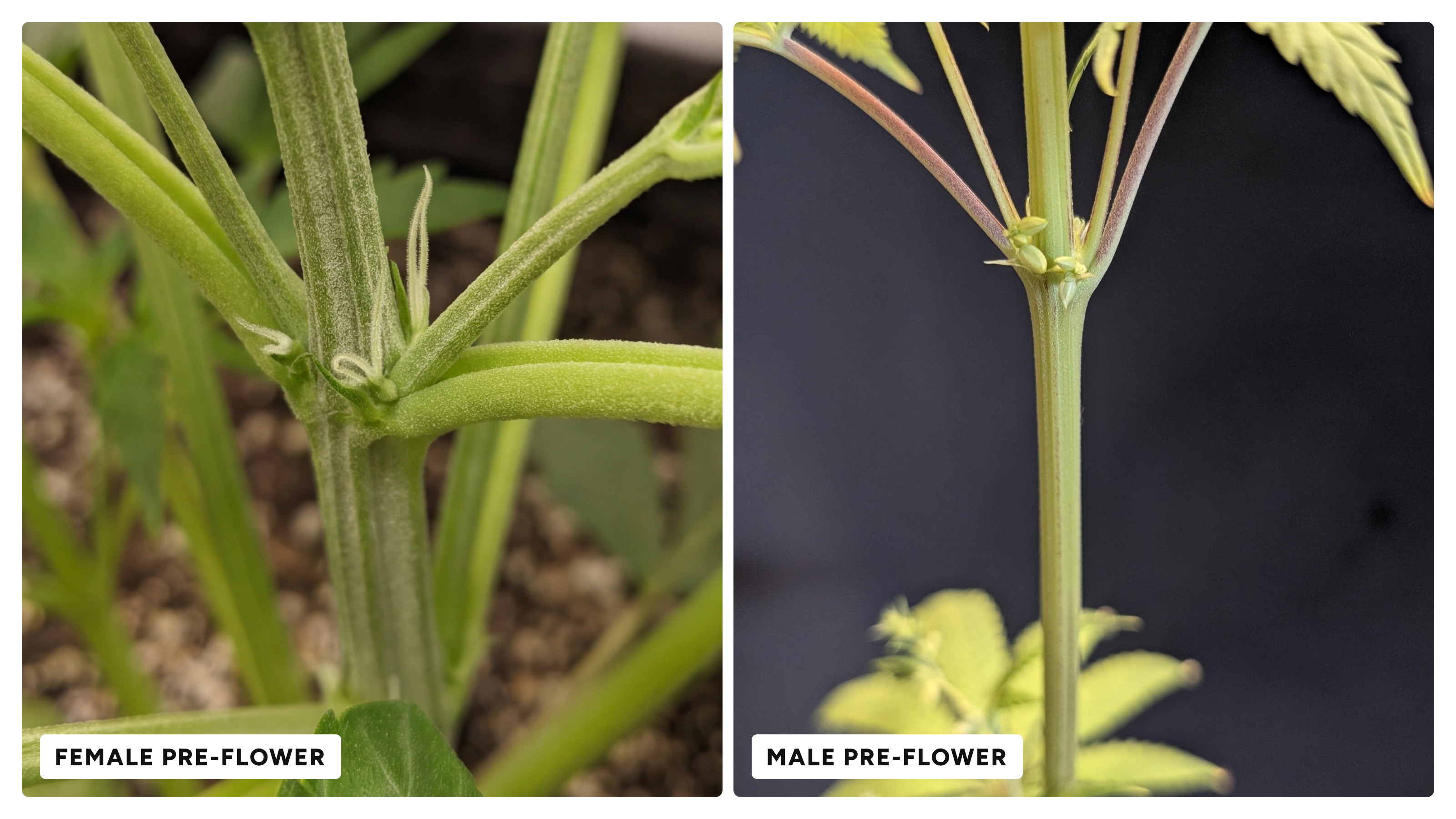
The two sexes solve the same problem from opposite ends. Female structures catch and protect, with stigmas reaching into moving air while the bracts and resin shield what sits behind them. Male structures release pollen and let the wind carry it to another plant.
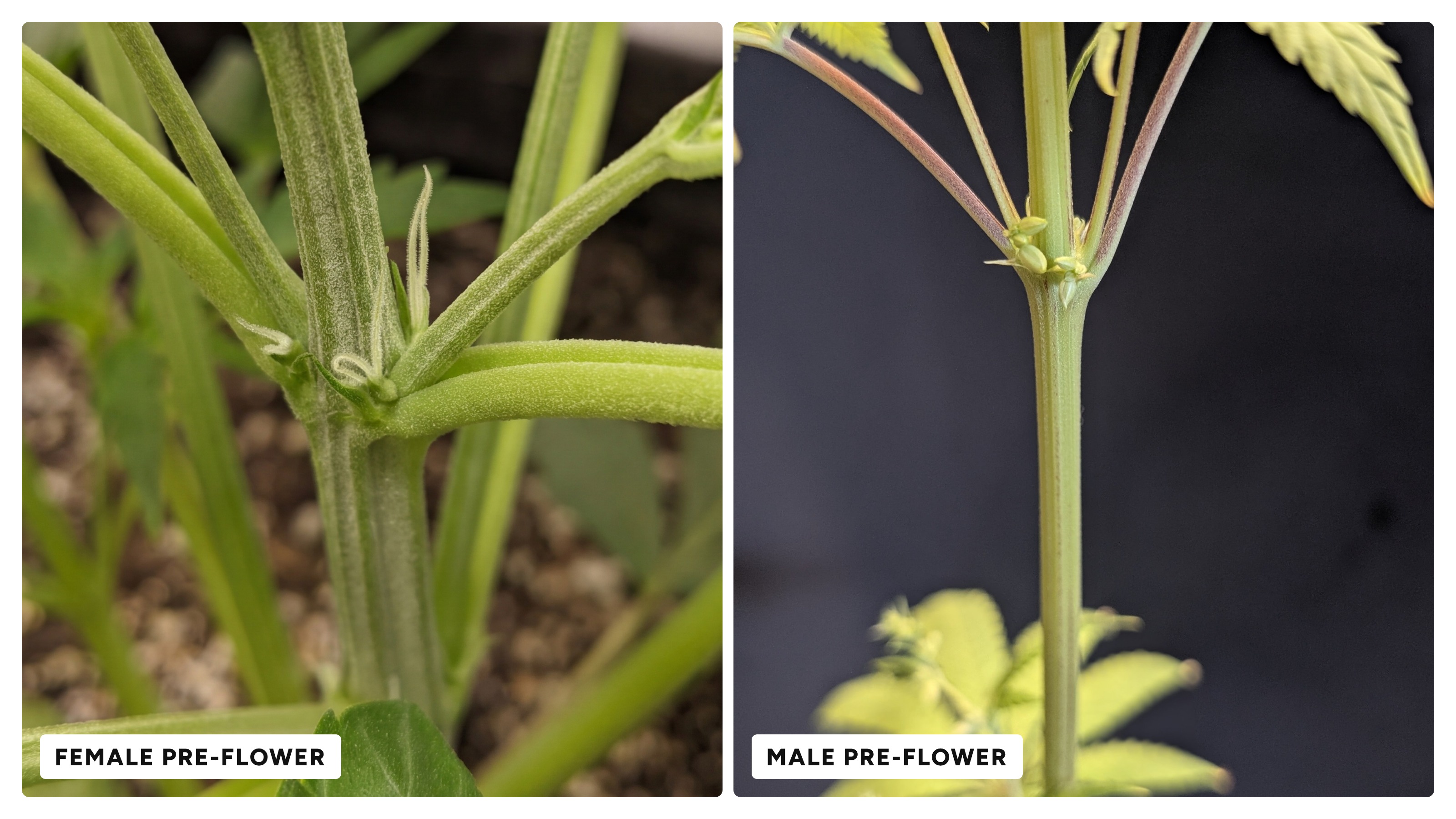
You can tell the sexes apart at the nodes before full flowering starts. Female pre-flowers are small teardrop shapes with fine white hairs, while male pre-flowers are rounder and hairless, one of the clearest early signs of a male plant.
What Happens When a Bud Is Pollinated
When pollen lands on a stigma and fertilization follows, the ovule inside that bract swells into a seed, and the bract becomes its casing. That’s why seeds turn up tucked inside a bud, each one marking where a single flower’s ovule used to be.
Pollination also redirects the plant’s resources. Energy that would’ve gone into further flower and resin development goes into seed production, so a fertilized flower develops along a different path from an unfertilized one.
Fertilization happens flower by flower, so how much of a bud is affected depends on how much pollen reached it. Seeds take roughly a month or more to mature after pollination.
Many growers sidestep the problem at the seed stage. Feminized weed seeds are bred to grow into female plants, so there’s much less sexing to do in early flower and a far lower risk of pollen finding your buds.
How to Read a Bud: Color, Density, and Frost
Every visible feature of a bud traces back to a structure you can now name. Color comes from pigments in the bract and leaf tissue and from how mature the stigmas are. Frost comes from trichome density, and density comes from genetics working with growing conditions.
Appearance tells you which structures are doing what and which conditions were in play. It can’t tell you whether a bud is any good.
Why Weed Buds Are Green, Purple, Orange, or White
Buds are usually green because chlorophyll dominates the bract and leaf tissue. Purple, magenta, red, and blue tones come from anthocyanin pigments, which depend on genetics, though environment can affect how strongly they show. Orange comes from matured stigmas, and white comes from dense trichomes.
Orange is the color people misread most often. The bud tissue underneath stays green, while the stigmas have matured from white through to orange, red, or brown. A white or silvery bud is typically showing a thick trichome layer, often alongside young, pale stigmas.
Since pigment, stigma maturity, and trichome cover all blend into one impression, two buds of the same cultivar can look like different colors.
Cannabis Bud Colors and What Causes Them
-
Green: Comes from chlorophyll in the bract and leaf tissue.
-
Purple, magenta, red, or blue: Comes from anthocyanin pigments, with color expression influenced by genetics.
-
Orange, red, or brown hairs: These are stigmas that have matured as the flower develops.
-
White or frosted appearance: Results from dense trichome coverage, often accompanied by young, white stigmas.
Dense Buds vs Airy Buds
Bud density comes from genetics and growing conditions working together. Genetics set the ceiling for how tightly a cultivar’s flowers can stack. Light, nutrition, temperature, and humidity decide how close a plant gets to that ceiling as it moves through the cannabis life cycle.
An airy bud isn’t always a sign of a problem. Some genetics naturally produce longer, looser flowers, and buds lower on the plant tend to finish looser than the ones on top.
Indica and sativa labels still describe plant shape well. Indica-leaning plants tend toward shorter growth, wider leaflets, and denser, more compact buds. Sativa-leaning plants tend toward taller growth, narrow leaflets, and longer, airier buds.
These are general tendencies, but they don’t reliably predict how a cultivar will affect you.
Frequently Asked Questions
Is Cannabis Flower the Same Thing as a Bud?
Yes, fower and bud both refer to the same structure, the developing or dried flower cluster of a female cannabis plant. The term just changes with the setting. Dispensary menus favor flower, while growers usually say bud.
How Many Parts Does a Cannabis Bud Have?
A bud has four visible parts: trichomes, bracts, stigmas, and sugar leaves, all growing around a central stem. Hidden inside each bract are the style, the ovule, and the perianth, which make up the rest of each tiny flower.
Can You See Trichomes Without a Microscope?
Partly. On a resinous bud, trichomes show up to the naked eye as a frosty coat of tiny glittering dots. To see individual head shapes and judge their color, you need magnification, such as a jeweler’s loupe or a pocket microscope.
What Is the Difference Between a Bud and a Nug?
There’s no anatomical difference between a bud and a nug. Nug, short for nugget, is informal shorthand for a single trimmed piece of flower, while bud covers the structure in general, whether it’s still growing on the plant or sitting in a jar.
How Can You Tell When Marijuana Buds Are Ready to Harvest?
Trichomes give the most reliable read. Under a loupe, their heads shift from clear to cloudy, then amber as the plant matures. Many growers harvest once most heads look cloudy and some have turned amber, with the exact balance coming down to personal preference. Stigma color is a rougher guide, since the hairs don’t always darken in step with the trichomes.


