
 SUPPORT
 SHIPPING INFO
 STRAIN FINDER

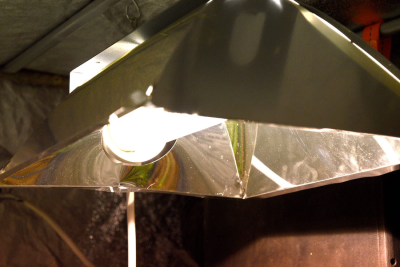
HPS and Metal Halide Grow Lights for Cannabis
Metal halide (MH) and high pressure sodium (HPS) lamps are two bulbs from the same HID family. They lit indoor cannabis grows for decades before LED panels became common. MH light leans blue and HPS light leans yellow-orange, which is why so many growers veg under MH and flower under HPS.
HID is also a cheaper way into indoor lighting than a comparable LED setup, at least upfront. The catch is heat. These lamps run hot, so you'll need enough clearance and airflow to keep your plants comfortable.
Below, you'll find what each bulb does and which one to run at each stage. You'll also learn what goes into a kit, how to size and hang it, what it costs to run, and how it compares with LED.
What HID Grow Lights Are: Metal Halide vs High Pressure Sodium
High intensity discharge (HID) lights make their glow by striking an electric arc inside a pressurized tube. Metal halide and high pressure sodium are the two types of HID lamps you'll see most often, and the main difference between them is color. MH puts out blue-leaning light, while HPS gives a yellow-orange glow weighted toward red.
Both pack a lot of light into one small, very bright source. That's a big structural difference from an LED panel, which spreads its output across lots of separate diodes. Neither one is just a household bulb in a bigger housing.
The color split is important because different wavelength balances are linked to different growth behaviors in cannabis plants. That's why growers think of MH and HPS as two separate tools for two jobs.
Almost everything else follows from that difference. It's behind the loose veg-and-flower split and the reason some growers buy two bulbs for one fixture. It's also why choosing a bulb and choosing a fixture are separate decisions.
Where Ceramic Metal Halide (CMH) Fits
Ceramic metal halide (CMH) is a newer version of metal halide that uses a ceramic arc tube. It gives you a broader, more daylight-like spectrum than either standard MH or red-weighted HPS lights.
Color rendering is high, with CRI figures of around 90 to 92 commonly quoted. That makes leaves easy to inspect, though CRI measures how colors look to people, not how useful the light is to plants.
You'll usually find CMH bulbs in two color temperatures: a red-weighted 3100K and a blue-weighted 4200K. Some growers run 3100K for the whole cycle, while others veg under 4200K and then switch.
Before you buy, check your ballast. CMH bulbs are specified for particular ballasts, so don't assume your existing MH/HPS ballast will drive one. Getting it wrong can damage the bulb.
Using MH and HPS Lights Through Veg and Flower
Most growers veg under metal halide and flower under HPS, swapping the bulb when plants move into bloom. Each bulb matches the stage growers associate with its side of the spectrum. It's common practice rather than a rule, so you've got three realistic setups to choose from:
- Two bulbs, one fixture. The classic route. Use an MH bulb through the vegetative stage, then fit the HPS bulb once your plants start flowering.
-
HPS only. The cheaper single-bulb option, and the one most growers go for if they only want one. HPS drives fast growth in veg as well as flowering. The trade-off is a bit more stretch between nodes, since it carries less blue light than MH.
-
MH only. The least common choice, since HPS is generally preferred once plants are in flower.
Swapping bulbs is easier than it sounds. If your ballast is rated for both lamp types, you just take one bulb out and put the other in the same hood. Going two-bulb doesn't mean buying two complete systems.
Keep in mind that the swap doesn't trigger flowering. Photoperiod plants start flowering once their uninterrupted dark period gets long enough, whatever bulb is above them. Setting that schedule is a separate job from choosing a bulb.
What an HPS or Metal Halide Grow Light Kit Includes
A working HID setup is more than a bulb you plug in and hang. You'll need a bulb, a ballast, and a reflector, plus hanging gear and a timer. You can buy them as a matched kit or as separate parts, and each piece has its own job:
- Bulb: The consumable at the heart of the system, in MH, HPS, or CMH form.
-
Ballast: Regulates the power the lamp needs to strike and then run steadily.
-
Reflector or hood: Houses the bulb and directs light down onto your canopy. The same hood will often take either bulb type for the veg-to-flower swap.
-
Hanging hardware: Ratchet hangers or chain, so you can raise and lower the fixture as your weed plants grow.
-
Timer: A plug-in timer that runs the lamp on a consistent daily schedule.
Budget for the parts that rarely come in the box. Timers and hanging gear are usually sold separately, and in most cases so is exhaust ventilation. Things get simpler at 150W, where nearly all fixtures have a built-in ballast and plug straight into the wall.
Magnetic vs Digital Ballasts
Magnetic ballasts use an older core-and-coil design that's heavy, simple, and mechanical. Digital or electronic ballasts are lighter, run close to silent, and are typically dimmable. They also waste less power than magnetic units, which helps your running costs, and many start the bulb more gently.
Dimming is the feature you'll likely appreciate most down the line. It lets you cut output and heat without rehanging or replacing the fixture, so one light works over young plants and full canopies alike.
Matching the Bulb to the Ballast
You can't assume any HID bulb will run on any ballast. Bulb and ballast have to match in both type and wattage, and only ballasts explicitly rated for both MH and HPS will run them interchangeably. That rating is what makes the veg-to-flower swap work.
CMH needs extra care here, since those bulbs are only made to run on particular ballasts.
Before you buy, compare the ballast's listed bulb types and wattage rating against the bulb's spec sheet. If a retailer says two parts are cross-compatible, confirm it with the manufacturer first.
Matching Wattage to Your Grow Space
Size your light to your canopy, not your room. Work out the area you actually plan to fill with plants, then pick a fixture that lights it evenly. Any wattage your plants can't use just heats the air, and the ballast's rating sets the size class you're buying into.
MH/HPS fixtures range from small plug-in units to high-wattage models, and coverage grows as wattage climbs. At the small end, a 150W fixture covers roughly 2 ft x 2 ft, making it an easy starting point. Going bigger in a small space adds intensity, but it also adds heat your room has to get rid of.
Once your light is up, a few habits help you get the most from that footprint:
-
Keep the canopy even and level. Light intensity drops off toward the edges, so several plants trained wide will use a fixture far better than one tall plant under the center.
-
Make reflective surfaces part of the plan. Light-colored walls or the reflective lining of a purpose-built grow room bounce side-spill back onto your plants instead of losing it.
-
Watch marijuana plants at the edges. They get less light than the plants in the center, so they'll show you whether your fixture really covers the area.
Wattage alone doesn't decide your harvest. Canopy coverage, your experience, and your genetics all shape the final result, so no honest yield figure can be tied to a bulb size.
Heat, Hanging Distance, and Ventilation
Every light turns the power it draws into heat, so 1,000W of LED warms a room as much as 1,000W of HID. HID runs hotter in practice because it needs more watts for the same light and throws more radiant heat onto the leaves. You can manage it by raising the light, moving air, and dimming if your ballast allows it.
Clearance depends on the fixture. Keep a 150W unit at least about 7 inches from your plant tops. A 600W or 1,000W HPS needs far more, roughly 18 to 36 inches in an air-cooled hood. In an open reflector with no cooling, give it roughly 36 to 48 inches.
Treat these figures as starting points, since manufacturer guidance comes first. That goes for CMH too, where published advice varies widely.
The hand test is a quick check you can run any time. Hold the back of your hand at canopy height, right under the center of the light, for several seconds. If it gets uncomfortable, the light's too close for your plant tops. Repeat it whenever you raise the fixture or your canopy grows toward it.
For an exact reading, point an infrared thermometer at the top leaves. Radiant heat from HID can push leaf temperature above what your room thermometer shows.
Ventilation matters even at the smallest wattage. A closed tent needs fresh air to replace the CO₂ your plants use and to carry off humidity along with heat. A common sizing target is an exhaust fan that clears the tent's air in under five minutes.
Running the lamp during the coolest part of the day also shifts heat away from the warmest hours. Once the heat's under control, you can fine-tune temperature and humidity with a few indoor climate control basics.
Running Costs, Bulb Life, and Replacement
HID lights are cheaper to buy but cost more to keep running, and their bulbs typically need replacing within about a year of regular use. Compared with LED, less of the electricity they draw becomes usable light. That means lighting the same canopy costs more, and so do the fans or cooling that deal with the heat.
Bulbs lose usable output well before they visibly fail, which is why you replace them on a schedule instead of waiting for one to quit. Go by the manufacturer's rated hours, since published lifespan figures vary a lot. CMH bulbs are often rated to last longer than standard HPS.
It helps to log the install date or run-hours of each bulb at the start of every cycle. Output fades too slowly to notice by eye, so back that log up with a light meter reading at canopy height.
A PAR meter is the most accurate option. On a tight budget, a smartphone light-metering app works if you measure from the same spot each time. Once readings drop noticeably below your first one, the bulb's due, whatever the calendar says.
If you're running the MH-to-HPS swap, budget for two bulbs. Each one only runs for part of the cycle, so they rack up hours on two separate clocks.
HID vs LED: Which Light Suits Your Grow?
On efficiency, LED is the stronger technology, and over enough run time it usually works out cheaper overall. HID still makes sense if you've got the headroom and ventilation for its heat and want to spend less upfront. The right choice depends on your setup, the space available, and the conditions you'll be working with when growing cannabis. Weigh these four factors in order to see where your grow lands:
-
Vertical height above the canopy. The hardest constraint to fix later, and the one HID clearance asks the most of.
-
Climate and extraction. Whether you can actually vent the heat in the hottest part of your year, not just the mildest.
-
Electricity price where you live. This is what turns a running-cost difference into a real number.
-
Upfront budget. It matters, but it comes last because the other three can make a cheap fixture unworkable.
Go with HID if you've got a ventilated space in a cooler climate, a tight starting budget, or HID gear you want to keep working. Go with LED if your ceiling's low, summer heat's already a struggle, or you'll run the light long enough for efficiency to win out.
CMH sits between the two as the broad-spectrum HID option, as long as your ballast is built for it. You can also add LED panels alongside existing HID to raise output. If LED is pulling ahead, the next step is learning how to choose an LED grow light for cannabis that fits your space, especially if you're planning your setup around specific cannabis seeds and their growing requirements.
Frequently Asked Questions
Do HID Grow Lights Need a Timer?
Yes, HID grow lights need to run on the same schedule every day. A mechanical or digital plug-in timer handles that for you, so you're not relying on memory. The right light schedule depends on your cannabis plants' stage and type, not the fixture.
Do HPS Bulbs Take a Few Minutes to Reach Full Brightness?
Yes, HID lamps need a few minutes to warm up before they reach full output, so don't judge brightness right after switching on. A hot lamp that's just been switched off usually needs to cool before it'll restrike too. That's why it's best not to flick the light on and off repeatedly.
Should I Handle a New MH or HPS Bulb With Bare Hands?
No — hold the bulb by its base or with a clean cloth, since manufacturers routinely advise against leaving residue on the glass. Only install or remove bulbs when the fixture's switched off and fully cooled, and follow any handling instructions that came with the lamp.
Can MH or HPS Lights Be Used in a Greenhouse?
Yes, HID-type lights like MH and HPS are often used in greenhouses as supplemental lighting alongside natural daylight, not as the only light source. The same rules still apply, so keep enough clearance above the canopy and make sure the bulb matches its ballast.
Do I Need Eye Protection Around HID Grow Lights?
Yes, it's a good idea to use eye protection around HID lamps since they’re bright and uncomfortable to look at directly. That’s why many growers wear grow-room glasses when working under a running light. The right lenses also make it much easier to judge true leaf color under an orange HPS.
How Do I Dispose of an Old MH or HPS Bulb?
Take your old MH or HPS bulb to a lamp recycling or household hazardous waste drop-off instead of putting it in your household trash. MH and HPS bulbs contain small amounts of mercury, which requires proper handling. Rules vary from place to place, and your local waste authority can point you to the nearest site.


